
TOEFL iBT® Take an Interview: how it works, with examples
Take an Interview is the last task of the TOEFL iBT test: a recorded interviewer asks you four questions on one topic, and you have 45 seconds to answer each. The questions change on the way: the first ones ask about your own life, the last ones ask what you think about a wider issue. This guide shows how each kind of question works, gives you a 45-second plan for each, and walks through a full interview with sample answers and notes. For 24 more practice questions by topic, see the Speaking questions and topics page.
By the Prepiva team · Last reviewed · How we make and review our content
On this page
What Take an Interview is
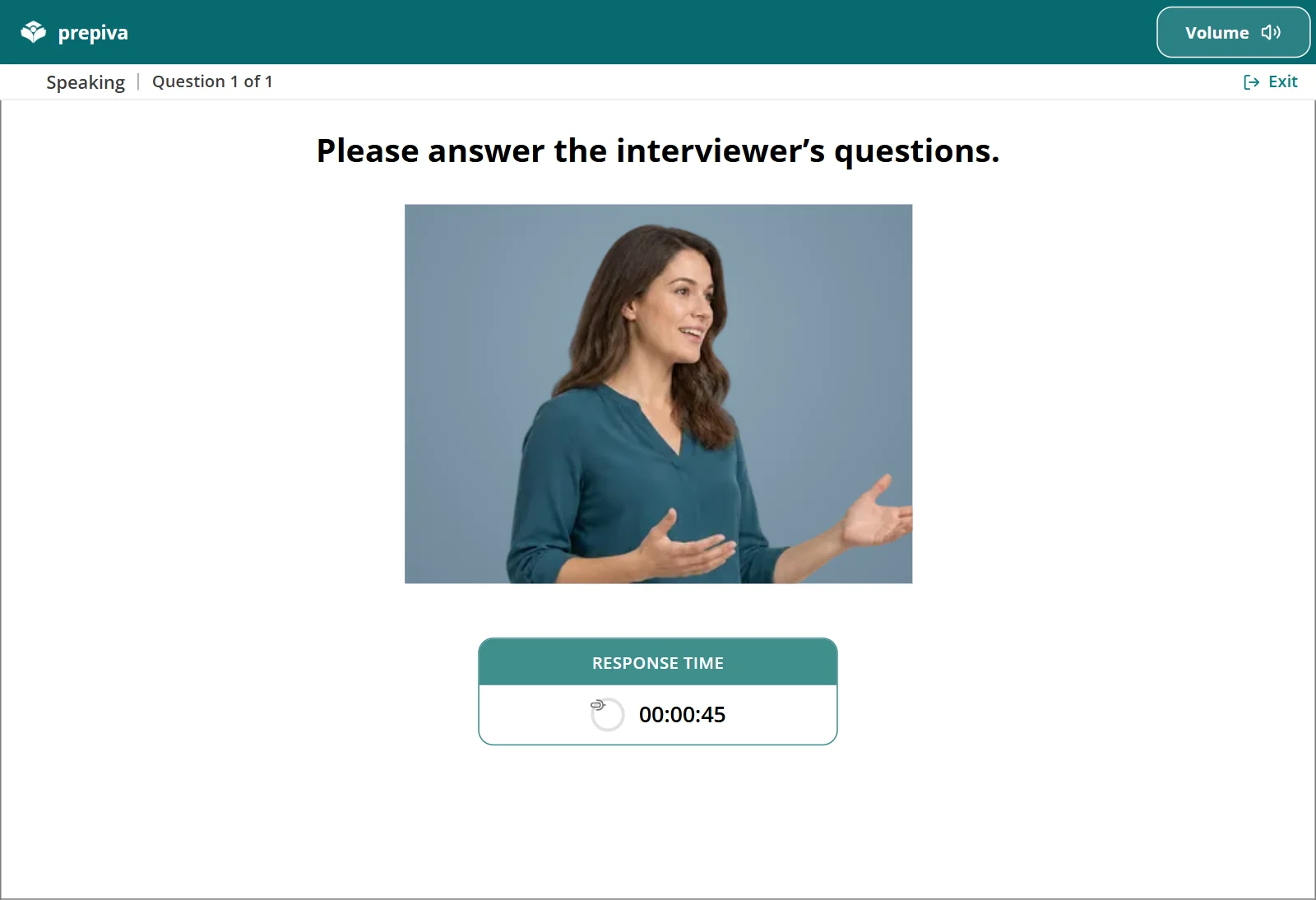
- What you hear: a recorded interviewer in a situation such as a research study or a scholarship application. A short introduction sets the scene.
- What you do: answer four questions on one topic, one at a time.
- Time: 45 seconds for each answer. There is no separate preparation time, so you plan while you speak.
- How it changes: the first questions ask about facts and your own experience; the later ones ask you to give and support an opinion on a broader issue.
- Scoring: each answer is scored from 0 to 5, with ETS’s scoring guide.
The four-question arc
| Question | What it asks | What a strong answer does | A way to start |
|---|---|---|---|
| 1 | Facts or your own experience | Describes with specific details: who, where, what | “In my family, …” |
| 2 | A memory or an example from your life | Tells one story in order, and why it mattered | “I remember…” |
| 3 | Your opinion | Takes a position, then gives a reason and an example | “I partly agree. …” |
| 4 | A broader issue | Weighs both sides, then decides | “On the one hand… In my view…” |
A 45-second plan for each kind
At a natural pace, 45 seconds is about 90 to 110 words: five or six sentences.
- Describing an experience: answer in the first sentence, add two or three specific details (a name, a place, a habit), and end with why it matters to you.
- Telling a memory: when and where, what happened, what happened next, and one line on what you learned.
- Giving an opinion: your position, one reason, one short example from your life, and a closing line.
- Weighing a broader issue: one side, the other side, then your view and why.
A full worked interview
The situation (new, written for this page): A researcher is studying how people celebrate special occasions, and you have agreed to a short online interview.
Question 1. To begin, could you tell me about a celebration that is important in your family? What usually happens on that day?
Sample answer: In my family, the most important celebration is my grandmother’s birthday in March. Every year, all of us travel to her house, even my cousins who live in other cities. My aunts cook for two days before, and my job is to decorate the living room with photos from her life. In the evening, we eat together, and each grandchild tells a short story about her. It’s the only day of the year when the whole family is in one place, so for me it matters even more than the national holidays.
Why it works: the first sentence answers the question, three concrete details follow (the travel, the cooking, the photos), and the last sentence says why the day matters.
Question 2. Now think about a celebration you remember especially well. What happened, and why do you remember it?
Sample answer: I remember my brother’s graduation party two years ago. We planned a picnic in the park, but an hour before it started, a big storm came. We had food for forty people and nowhere to put them. In the end, our neighbor offered his garage, so we moved everything there and hung lights from the ceiling. It was crowded and a bit cold, but everyone said it was our best party ever, probably because we built it together at the last minute. Since then, we always have a plan B.
Why it works: one story told in order (the plan, the problem, the solution), with time words that guide the listener, and a closing line that answers “why do you remember it”.
Question 3. Some people say that birthday parties and other celebrations have become too expensive. Do you agree? Why or why not?
Sample answer: I partly agree. Some celebrations really have become expensive, especially weddings and children’s parties, where families feel they have to rent a hall and hire entertainment. But I don’t think celebrations have to cost a lot. The best birthday I’ve had was a dinner at home with five friends, and it cost almost nothing. So I’d say the problem isn’t celebrating, it’s the pressure to copy what other people show online. If people focused on the time together, they could spend much less.
Why it works: a clear position in two words, a reason for each side, one personal example and a closing line that explains the speaker’s view.
Question 4. Some people think traditions should change as society changes, while others think they should be kept as they are. What is your view?
Sample answer: I think traditions should change a little, as long as their meaning stays the same. In my grandparents’ time, the New Year meal was only for close family, and it lasted the whole day. Now many families invite friends too, and the meal is shorter because people work the next day. But the meaning, starting the year together, hasn’t changed. On the other hand, if a tradition stops making sense to young people, they simply drop it. So a little change helps a tradition survive.
Why it works: the position comes first, then an example of a tradition that changed, then the other side, and a conclusion that follows from both.
Each answer has 83 to 92 words: about 40 seconds at a natural pace, which leaves a moment to start and to finish calmly.
By starting, you agree to the Terms of Service and Privacy Policy.
Keeping a natural pace
- No opinion on the topic? Choose the side that is easier to explain and give one real example. The question tests your English, not your beliefs.
- Finished early? Add a result (“so now I…”) or a second short example. Silence wastes the time you have.
- Lost a word? Say it another way and keep going: “the… the room where they keep the cars” works.
- A two-part question? Answer both parts: “What happened, and why do you remember it?” asks for a story and a reason.
What the scoring guide rewards
ETS’s scoring guide gives each answer a score from 0 to 5. In plain words, a 5 answers the question fully, stays on topic with good detail, keeps a natural conversational pace with natural pauses, is easy to understand with helpful rhythm and intonation, and uses a range of accurate grammar and words. A 4 is reasonably clear but may lack linking words or pause a little more. A 3 has limited detail, a choppy pace with frequent fillers, or a narrower range of language. ETS scores Speaking with its AI scoring engine, which is trained on human ratings; human raters help check its accuracy.
Common mistakes
- Long silences while you plan a perfect sentence.
- Memorized answers that do not fit the question.
- Answering only half of a two-part question.
- Speaking too fast to finish, which makes you harder to understand.
How to practice
- Record four answers a day on one topic, with a 45-second timer, from experience questions to opinion questions.
- Listen back and check that your first sentence answers the question.
- Use new topics: the Speaking questions and topics page has 24 questions in six sets.
Practice on Prepiva
Practice Exam 01, Prepiva’s free full practice test, ends with a full Speaking section in the 2026 format, and its score report includes a Speaking rating after a free sign-up. Prepiva Pro adds Speaking practice sets with AI evaluation, for $19.99 a month or $39.99 for 3 months. Before the interview, the Speaking section starts with Listen and Repeat; or take the full practice test.
By starting, you agree to the Terms of Service and Privacy Policy.
FAQ
How many interview questions are there?
Four, all on one topic.
How long do I have for each answer?
45 seconds.
Is there time to prepare?
No separate preparation time. Your answer time starts after the question, so you plan while you speak.
Do the questions get harder?
Yes. The first questions ask about facts and your own experience; the later ones ask for your opinion on broader issues.
How is the interview scored?
Each answer is scored from 0 to 5 with ETS’s scoring guide. The Speaking section result is a band from 1 to 6, in half steps.