
The 2026 TOEFL iBT® test format, section by section
The TOEFL iBT test changed on January 21, 2026. It now has new task types, adaptive Reading and Listening sections, and scores on a 1–6 band scale. This page explains the whole test, section by section, with the number of questions, the time, each task type and what the screen asks you to do. In India, many test takers call this the TOEFL exam pattern; the “pattern and syllabus” section below explains how those words fit the 2026 test.
By the Prepiva team · Last reviewed · How we make and review our content
On this page
The 2026 test at a glance
| Section | Task types | Questions | Time (about) | Adaptive |
|---|---|---|---|---|
| Reading | Complete the Words, Read in Daily Life, Read an Academic Passage | 50 | 30 minutes | Yes, two stages |
| Listening | Listen and Choose a Response, Listen to a Conversation, Listen to an Announcement, Listen to an Academic Talk | 47 | 29 minutes | Yes, two stages |
| Writing | Build a Sentence, Write an Email, Write for an Academic Discussion | 12 | 23 minutes | No |
| Speaking | Listen and Repeat, Take an Interview | 11 | 8 minutes | No |
| Total | 12 task types | 120 | about 90 minutes |
The sections always come in this order: Reading, Listening, Writing, Speaking.
The times in the table are ETS’s base times. They do not include directions, so ETS asks test takers to allow about two hours for the whole test. Because Reading and Listening adapt to you, ETS also notes that the time and the number of questions can vary a little.
How the adaptive sections work: in Reading and Listening, everyone takes the same first stage. Your answers there decide whether your second stage is easier or harder. You cannot skip ahead or go back between the stages, and your score is based on both stages. Writing and Speaking are linear: everyone taking the same version of the test gets the same tasks.
Choosing between tests? See how it compares with IELTS.
By starting, you agree to the Terms of Service and Privacy Policy.
What changed on January 21, 2026
- New task types. Several tasks measure basic language skills directly: Complete the Words, Build a Sentence and Listen and Repeat. Others use everyday situations, such as writing an email or answering interview questions.
- Content from today’s academic life. Reading texts come from academic sources and also from newspapers, magazines, websites and social media. Listening includes campus announcements and conversations as well as academic talks.
- Adaptive Reading and Listening. The second stage of each section matches your level, as described above.
- A new score scale. Each section and the overall score are reported as bands from 1 to 6, in half steps, aligned with CEFR levels. Until January 2028, score reports also show a comparable score on the old 0–120 scale. Read more about TOEFL iBT® scores.
Reading
Reading has three task types:
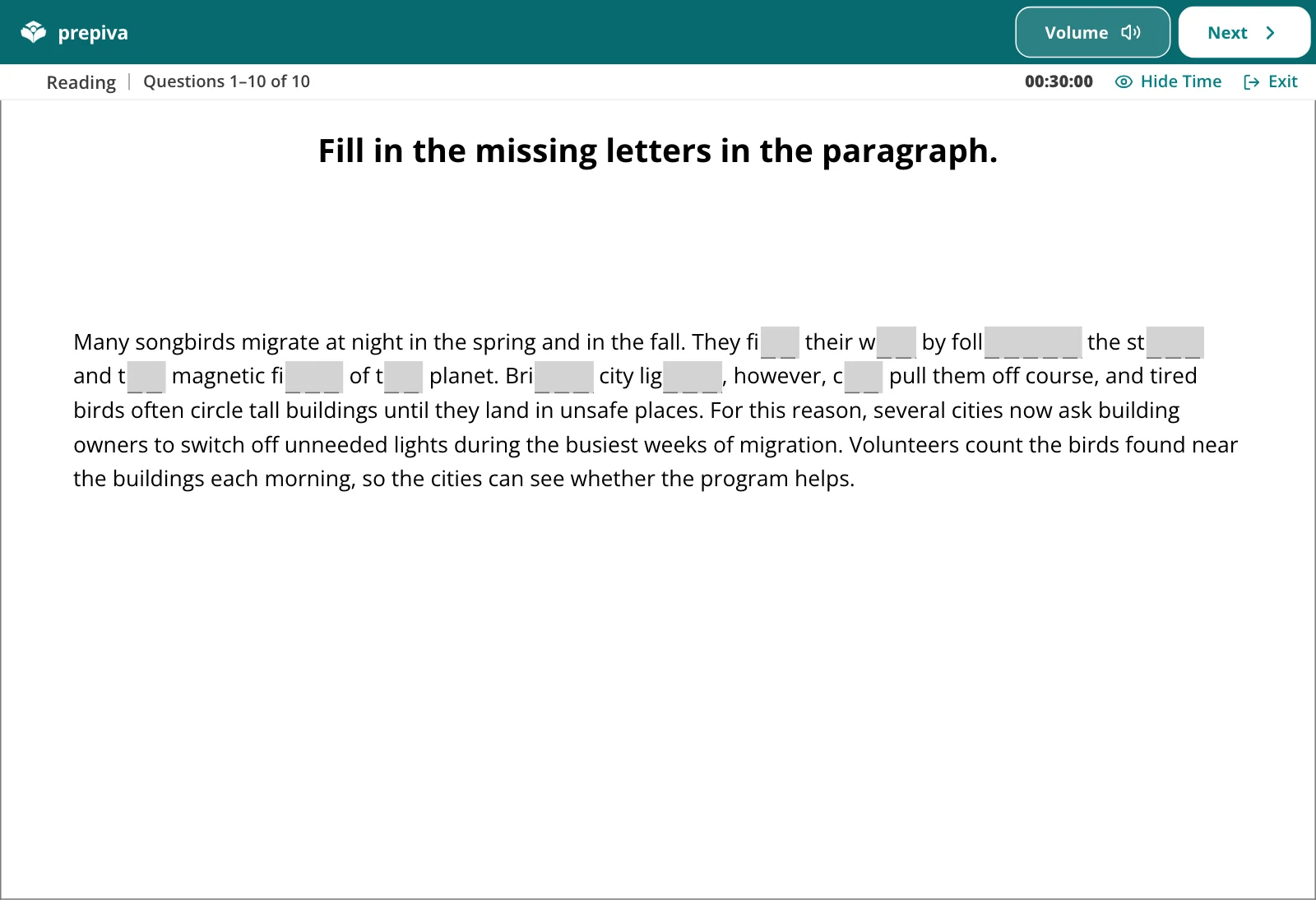
- Complete the Words: a short academic paragraph in which the second half of every second word is missing. You type the missing letters. It tests vocabulary and meaning from context.
- Read in Daily Life: short everyday texts such as notices, emails, menus and social media posts, each with two or three questions.
- Read an Academic Passage: an academic text of up to about 200 words with questions about the main idea, details, vocabulary and what the writer implies.
The text stays on the screen while you answer. Every scored question is worth one point. You can see sample questions with answers and practice the Reading section on our Reading page.
Listening
Listening has four task types:
- Listen and Choose a Response: you hear one sentence and choose the best reply.
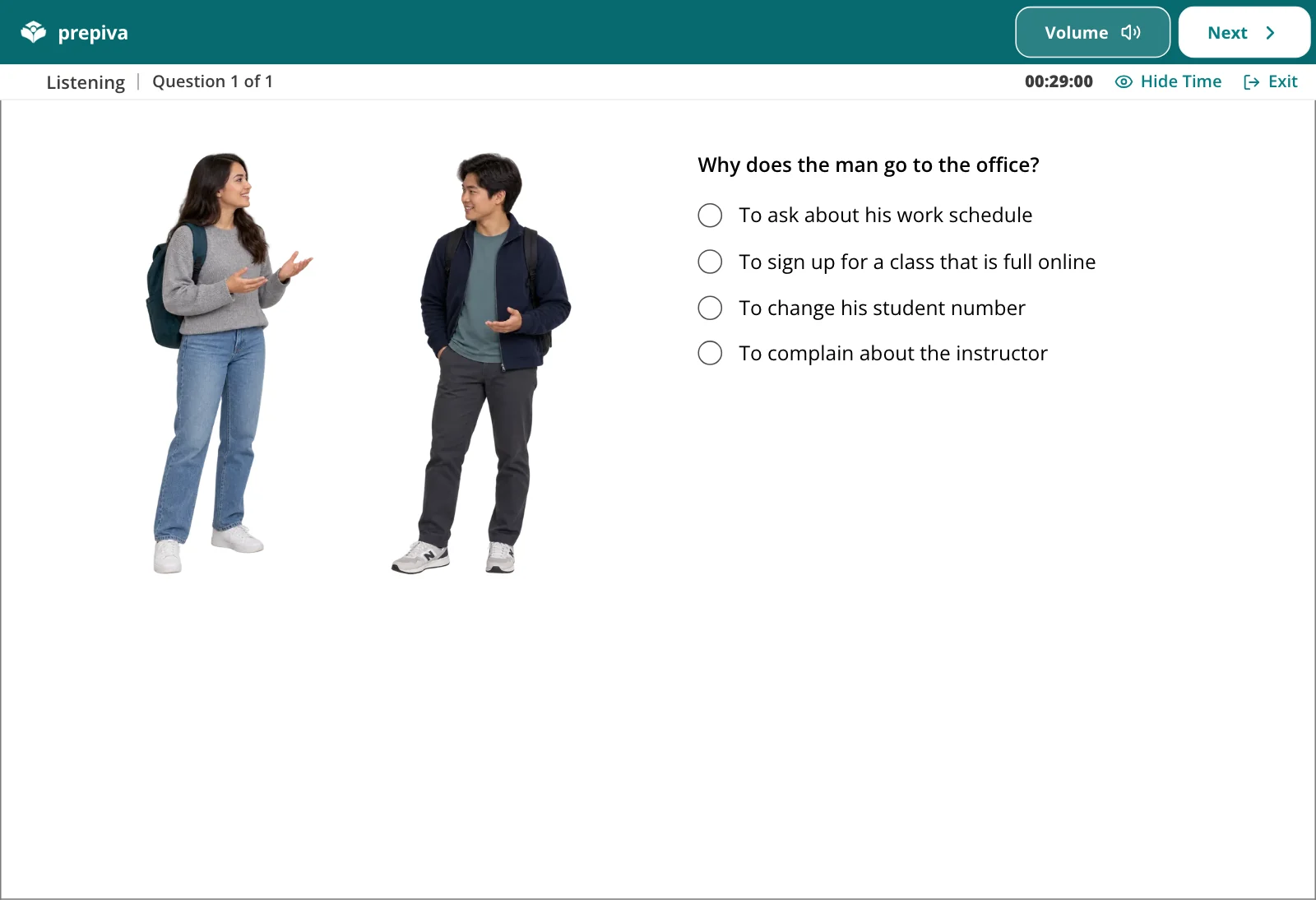
- Listen to a Conversation: a short conversation between two people, followed by questions.
- Listen to an Announcement: a campus or class announcement, followed by questions.
- Listen to an Academic Talk: part of a lecture, up to about 250 words, followed by questions.
Each recording plays only once. A picture of the speaker or speakers is shown while you listen, and you may take notes. Every scored question is worth one point. Hear samples with their scripts and practice the Listening section on our Listening page.
Writing
Writing has three task types, 12 questions in about 23 minutes:
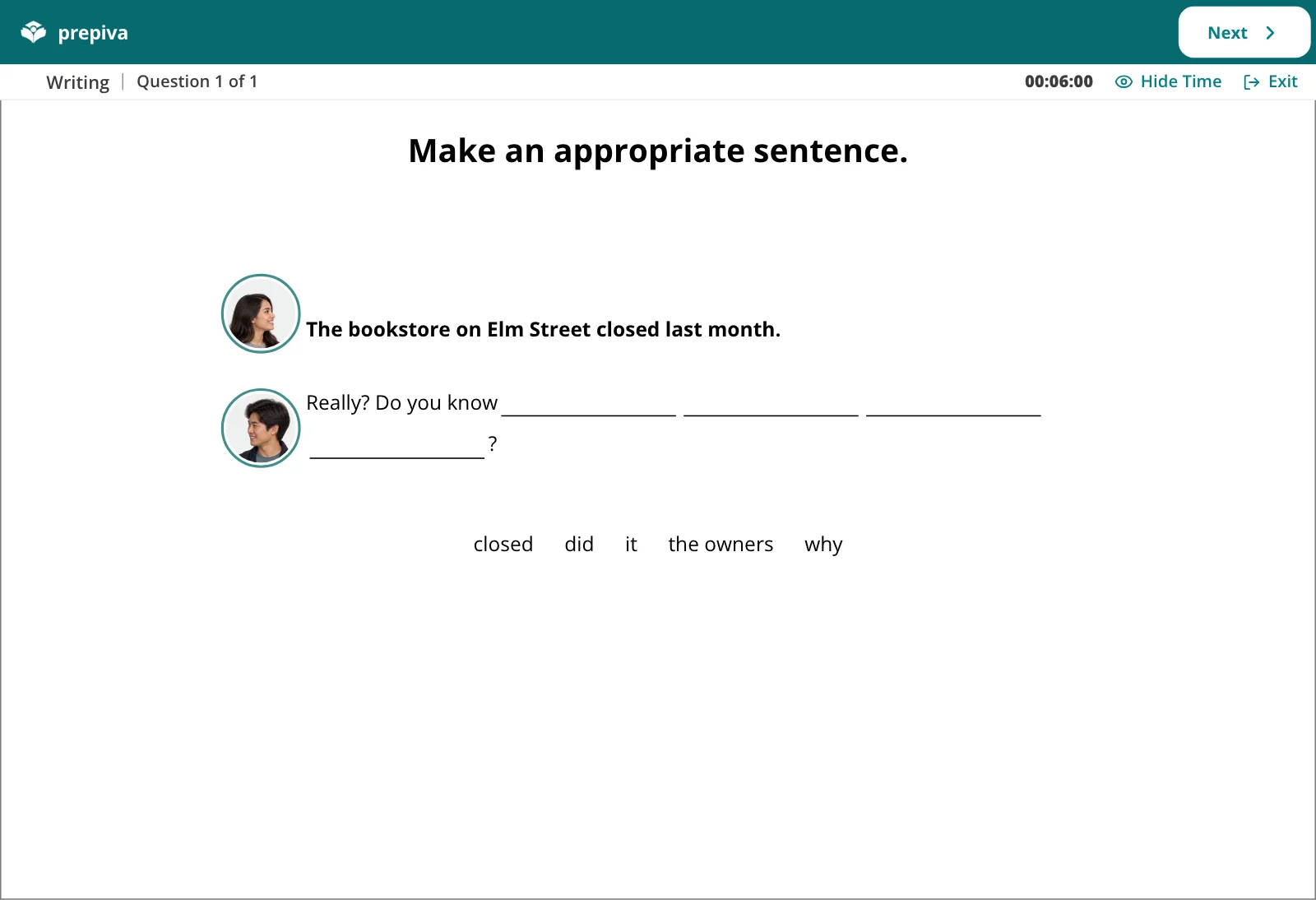
- Build a Sentence (10 questions): you put groups of words in the right order to complete a reply in a short exchange. Each item is right or wrong.
- Write an Email (1 task, 7 minutes): you write a practical email that covers the points the task gives you.
- Write for an Academic Discussion (1 task, 10 minutes): you read a professor’s question and two students’ posts, then add your own view.
The email and the discussion post are each scored from 0 to 5. ETS scores them with its AI scoring engine, which is trained on human ratings, and human raters help check its accuracy.
See sample Writing answers for all three tasks.
Speaking
Speaking has two task types, 11 questions in about 8 minutes:
- Listen and Repeat (7 sentences): you hear one sentence at a time, each only once, and repeat exactly what you heard. You have about 8 to 12 seconds to record each sentence.
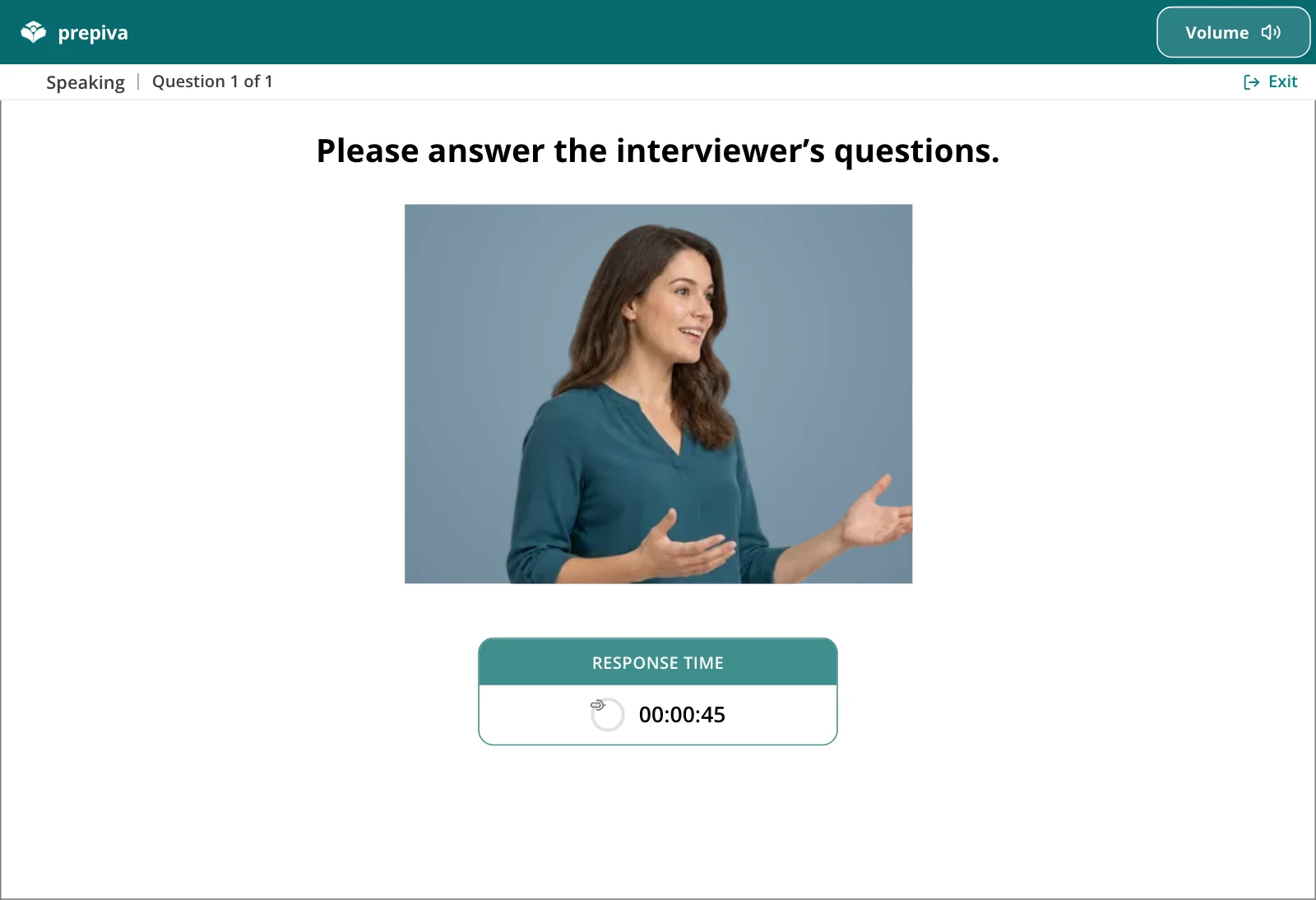
- Take an Interview (4 questions): a recorded interviewer asks four questions on one topic, about your experiences and opinions. You have 45 seconds for each answer.
Each answer is scored from 0 to 5. You speak into a microphone, so check it before you start; Prepiva’s Speaking section begins with a microphone check.
Practice with original Speaking questions and topics.
TOEFL exam pattern and syllabus
“Exam pattern” usually means the structure of the test: the sections, their order, the number of questions and the time. For the 2026 TOEFL iBT test, the pattern is the table at the top of this page: four sections in a fixed order, 12 task types, 120 questions and about 90 minutes of timed sections, plus directions.
There is no syllabus in the sense of a book list or a set of topics to learn. The test measures how well you read, listen, write and speak in academic and everyday English, at every level from A1 to C2. The topics change from test to test. To prepare, learn how each task type works and practice the skill it measures, starting with the section where your band is lowest. Our study plan shows one way to do this.
Test day, at a test center or at home
You can take the TOEFL iBT test at a test center or at home with the TOEFL iBT Home Edition. ETS sets the rules for both, including ID, equipment and notes. For example, test centers give you scratch paper and pencils, and at home you write notes with an erasable marker on a whiteboard or on paper inside a clear sheet protector. Check the current rules on ETS’s Home Edition page and ETS’s test-day pages before you register. Fees, dates and registration are also on ETS’s site.
The best preparation for the format is to take a timed practice test: try the format in a full practice test.
By starting, you agree to the Terms of Service and Privacy Policy.
FAQ
How long is the TOEFL iBT test in 2026?
The four sections have about 90 minutes of base time: Reading 30 minutes, Listening 29, Writing 23 and Speaking 8. Directions are not included, so ETS asks you to allow about two hours.
What are the sections of the TOEFL iBT test?
Reading, Listening, Writing and Speaking, always in that order.
What changed in the 2026 TOEFL iBT test?
New task types, adaptive Reading and Listening sections, content from everyday and academic life, and scores on a 1–6 band scale.
Is there a TOEFL syllabus?
No fixed reading list or topic list. The test measures four skills through the 12 task types described on this page.
What does the TOEFL test screen look like?
This page shows Prepiva’s own practice screens for each section, so you can see the task formats before test day. They are not ETS screens. To see ETS’s screens, try the free sample test on ETS’s website.