Skip to content

TOEFL iBT® Reading practice for the 2026 test

Reading is the first section of the TOEFL iBT test. Since January 21, 2026, it has three task types: Complete the Words, Read in Daily Life and Read an Academic Passage. This page explains each one, gives you a new sample of each with the answers, and shows how the section is scored. When you are ready, practice with Prepiva’s free Reading sets.

By the Prepiva team · Last reviewed · How we make and review our content

On this page

The Reading section at a glance

  • Questions and time: 50 questions in about 30 minutes. ETS notes that, because the section adapts, the time and the number of questions can vary.
  • Two stages: everyone takes the same first stage. Your answers there decide whether the second stage is easier or harder. Your score is based on both stages, and you cannot go back from the second stage to the first.
  • Three task types: Complete the Words, Read in Daily Life and Read an Academic Passage.
  • Texts: from short everyday messages of 15 to 50 words up to academic passages of about 200 words. The text stays on the screen while you answer.
  • Unscored questions: ETS includes some try-out questions in Reading or Listening that do not count. You cannot rely on spotting them, so answer every question with care.
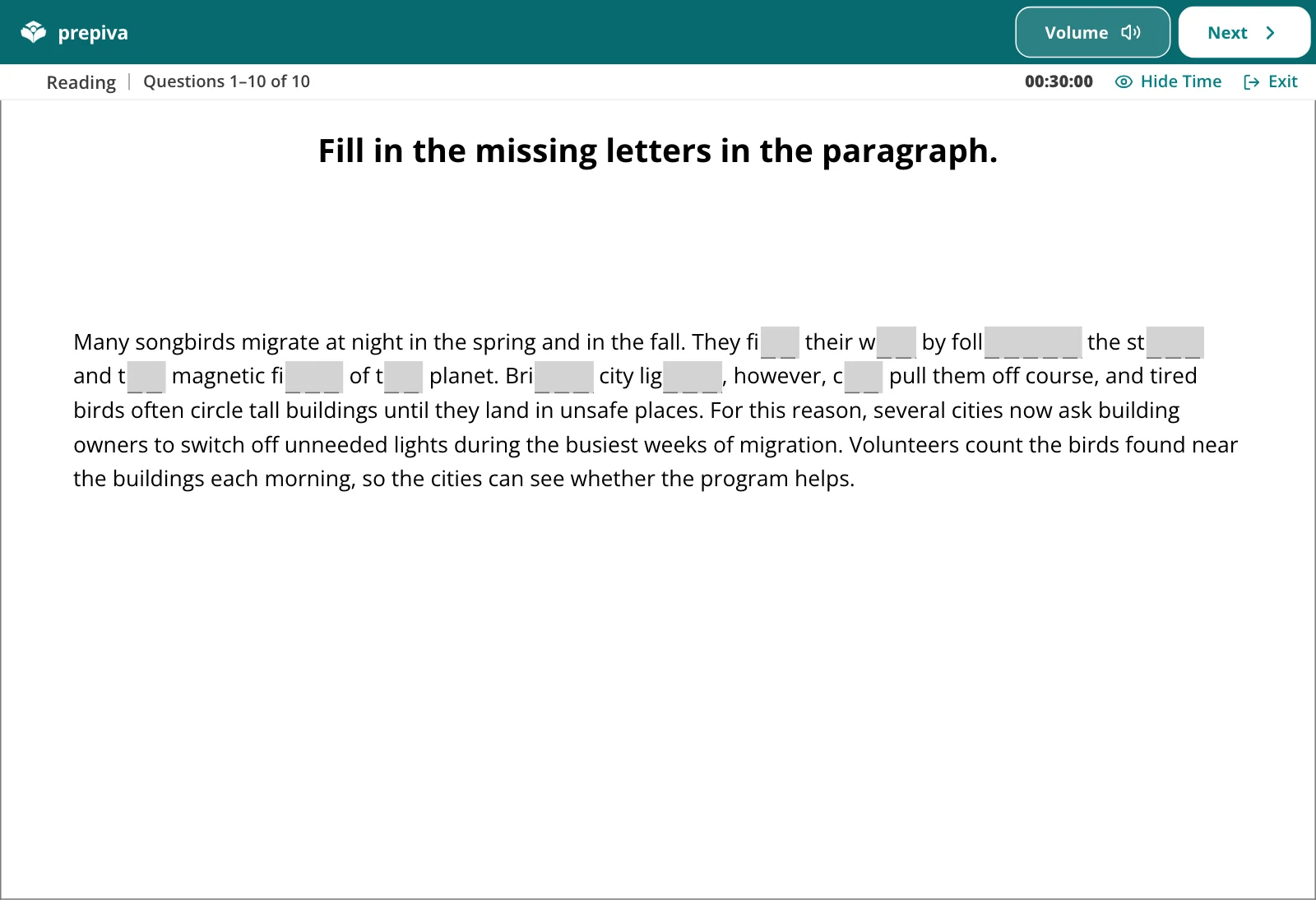
Prepiva practice screen: Reading, Complete the Words
Prepiva practice screen

Reading is followed by Listening, Writing and Speaking. See the full test format for all four sections.

Complete the Words

What it tests: your vocabulary and your ability to understand meaning from context.

What you see: a short academic paragraph of about 70 to 100 words. The first sentence is complete. After that, the second half of every second word is missing, ten words in all. You type the missing letters. In this sample, each line (_) stands for one letter.

Sample paragraph (new, written for this page)

Many songbirds migrate at night in the spring and in the fall. They fi (2 missing letters) their w (2 missing letters) by foll (5 missing letters) the st (3 missing letters) and t (2 missing letters) magnetic fi (3 missing letters) of t (2 missing letters) planet. Bri (3 missing letters) city lig (3 missing letters), however, c (2 missing letters) pull them off course, and tired birds often circle tall buildings until they land in unsafe places. For this reason, several cities now ask building owners to switch off unneeded lights during the busiest weeks of migration. Volunteers count the birds found near the buildings each morning, so the cities can see whether the program helps.

Show the answers

Answers: 1 find, 2 way, 3 following, 4 stars, 5 the, 6 field, 7 the, 8 Bright, 9 lights, 10 can.
Two strategies from Prepiva’s guide:

  1. Read the whole paragraph first. The rest of the text often makes a word obvious. Here, “pull them off course” and “lights during the busiest weeks” tell you that the gaps are about lights and finding the way. Fill the easy words on your first pass.
  2. Count the letters and let grammar choose the form. The beginning of the word plus the number of missing letters usually leaves one answer. “foll_____” has five missing letters, and after “by” English needs an -ing form: following.

For a three-check method and two more worked paragraphs, read the full Complete the Words guide.

Read in Daily Life

What it tests: whether you can understand short, everyday texts: notices, emails, menus, schedules, text messages and social media posts.

What you see: a short text, then two or three questions with four options each. The text stays on the screen.

Sample text (new, written for this page)

Riverside Community Pool: schedule change

From June 3 to June 14, the main pool will close at 6 p.m. instead of 9 p.m. while new lights are installed. The small pool will keep its usual hours. Swimmers with an evening pass can use it at the Hill Street pool during these two weeks at no extra cost. Questions? Ask at the front desk.

Question 1. What is the main purpose of the notice?

  • A.To announce new swimming classes
  • B.To explain a temporary change in opening hours
  • C.To ask swimmers to buy evening passes
  • D.To introduce a new pool on Hill Street
Show the answer

Answer: B. The notice is about two weeks of shorter hours at the main pool. Classes and new passes are not mentioned, and the Hill Street pool is not new.

Question 2. What can a swimmer with an evening pass do on June 10?

  • A.Swim in the main pool until 9 p.m.
  • B.Use the Hill Street pool without paying more
  • C.Get a refund at the front desk
  • D.Swim only in the small pool
Show the answer

Answer: B. June 10 falls between June 3 and June 14, and the notice says evening passes work at Hill Street “at no extra cost”. A is wrong because the main pool closes at 6 p.m. The notice never mentions refunds, and it does not limit pass holders to the small pool.

For the main text types, four question types and three more worked texts, read the full Read in Daily Life guide.

Read an Academic Passage

What it tests: whether you can follow a short academic text: its main idea, its details, the meaning of words in context, and what the writer implies.

What you see: a passage of about 200 words in two or three paragraphs, with a title, and about five questions. The passage stays on the left while each question appears on the right.

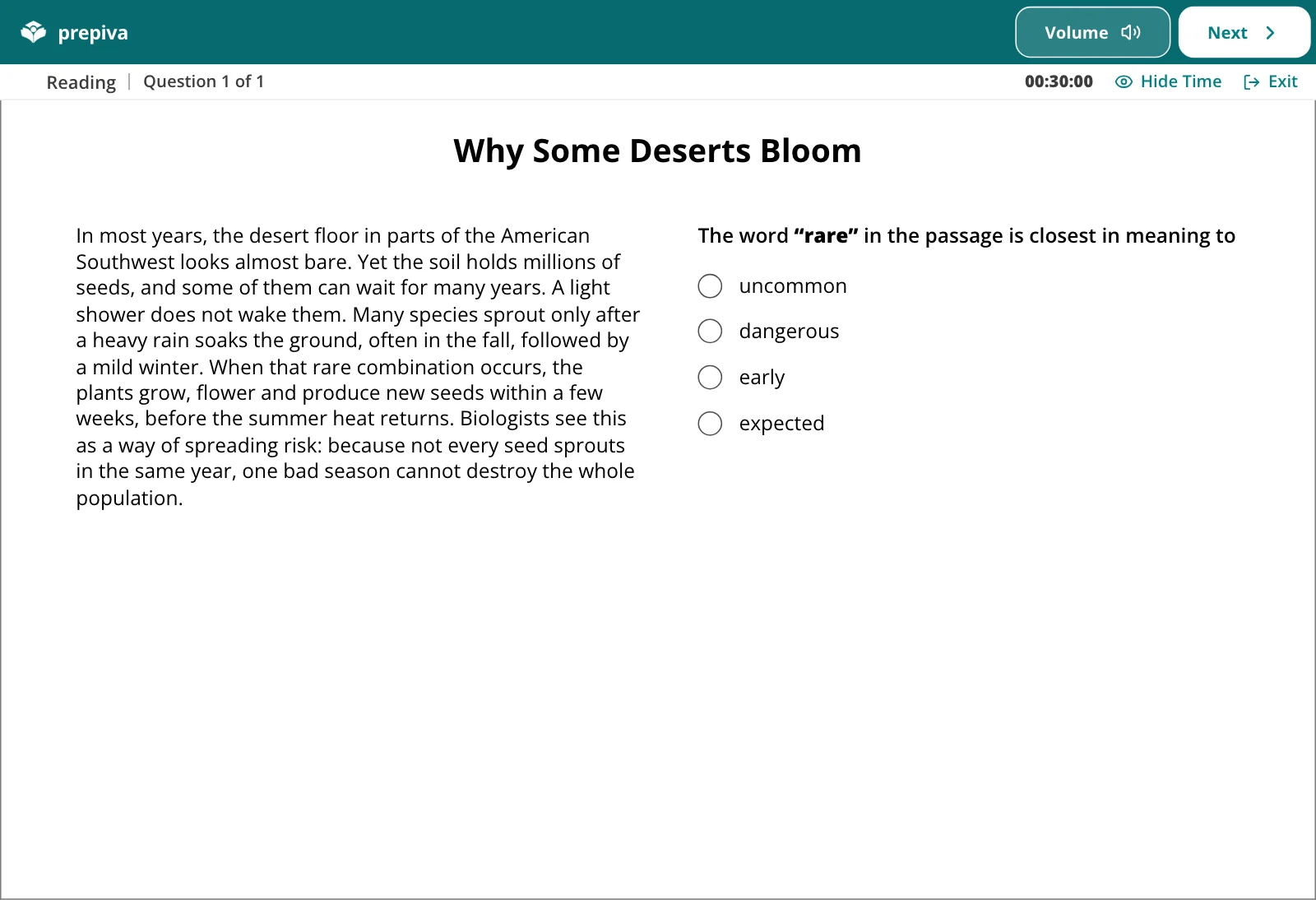
Prepiva practice screen: Reading, Read an Academic Passage, with the passage and one question
Prepiva practice screen

Sample excerpt (new, written for this page; the full task has a longer passage and more questions)

Why Some Deserts Bloom

In most years, the desert floor in parts of the American Southwest looks almost bare. Yet the soil holds millions of seeds, and some of them can wait for many years. A light shower does not wake them. Many species sprout only after a heavy rain soaks the ground, often in the fall, followed by a mild winter. When that rare combination occurs, the plants grow, flower and produce new seeds within a few weeks, before the summer heat returns. Biologists see this as a way of spreading risk: because not every seed sprouts in the same year, one bad season cannot destroy the whole population.

Question 1. The word “rare” in the passage is closest in meaning to

  • A.uncommon
  • B.dangerous
  • C.early
  • D.expected
Show the answer

Answer: A. A heavy fall rain followed by a mild winter does not happen in most years, so the combination is uncommon.

Question 2. According to the passage, why do the seeds not all sprout in the same year?

  • A.Animals eat most of the seeds each year.
  • B.It protects the species if one season goes badly.
  • C.The seeds need several winters to grow.
  • D.Biologists collect some of the seeds for study.
Show the answer

Answer: B. The last sentence says that, because the seeds sprout in different years, one bad season cannot destroy the whole population. The passage does not mention animals, several winters or collecting seeds.

To see all five question types on a full passage, read the full Read an Academic Passage guide.

How Reading is scored

Your Reading score is a band from 1 to 6, in half steps. Each scored question is worth one point. ETS bases the score on the number of questions you answer correctly across both stages and on how difficult those questions are.

Your Reading band is one of four section bands. Your overall band is the average of the four, rounded to the nearest half band. See how the 1–6 band scale works, with the CEFR level and the comparable 0–120 range for each band.

On Prepiva, your Reading band is a practice estimate. How we estimate bands explains the method and its limits.

Common mistakes

These traps come from Prepiva’s guides for the three Reading tasks:

  • Complete the Words: choosing the right word in the wrong form (wrong tense, singular instead of plural); spending a long time on one hard word while easier ones wait; ignoring the sentence after the gap, which often confirms the meaning.
  • Read in Daily Life: choosing an option that copies words from the text but changes who does what, or when; choosing something that is true in general but not stated in this text.
  • Read an Academic Passage: choosing “always” or “never” when the passage says “often” or “may”; choosing facts from your own general knowledge that the passage never states.

Practice Reading free on Prepiva

Prepiva has three Reading practice sets with their own passages. They are free with a Prepiva account, and after each set you can review your answers to see what you missed. When the three task types feel familiar, take the full practice test to get a band for all four sections. You can also try the Listening questions next.

FAQ

How many questions are in the TOEFL Reading section?

50 questions in about 30 minutes, according to ETS. Because the section adapts, the time and the number of questions can vary. Prepiva’s practice tests use 50 questions in 30 minutes.

Is the TOEFL Reading section adaptive?

Yes. Reading has two stages. Your answers in the first stage decide whether the second stage is easier or harder, and your score is based on both.

What are the Reading task types in 2026?

Complete the Words, Read in Daily Life and Read an Academic Passage.

How can I practice TOEFL Reading questions for free?

Start with the sample questions on this page. Then use Prepiva’s three free Reading practice sets, which need a free account. ETS also offers free sample tests on its website.

How is the Reading section scored?

On a band scale from 1 to 6, in half steps. Each scored question is worth one point, and ETS also takes into account how difficult the questions in your two stages were.