TOEFL iBT® Speaking questions and topics for the 2026 test
Speaking is the last section of the TOEFL iBT test. Since January 21, 2026, it has two tasks: Listen and Repeat, and Take an Interview. This page explains both, with new sample sentences to repeat, a simple method for interview answers with one worked example, and 24 original practice questions grouped by topic. When you are ready to hear how you sound, Prepiva’s free full practice test rates your Speaking.
Questions and time: 11 questions in about 8 minutes, according to ETS.
Two tasks: Listen and Repeat (7 sentences) and Take an Interview (4 questions).
Not adaptive: everyone who takes the same version of the test gets the same Speaking tasks.
Each task starts with a short scenario that you both hear and read, with a picture of the setting or the speaker.
No separate preparation time: you repeat each sentence after a short pause, and you have 45 seconds to answer each interview question. You plan while you speak.
You speak into a microphone, and your answers are recorded. See the full test format for all four sections.
Listen and Repeat
What it tests: whether you can understand a sentence and say it back accurately and clearly.
What you hear: seven sentences from one situation on campus or in academic life, such as a guide or a manager explaining a place. A picture of the setting is on the screen. After each sentence there is a short pause, and then you repeat exactly what you heard. The sentences get longer and more complex as you go, and you have up to 8 to 12 seconds to record each one.
Sample (new, written for this page)
You are a new student assistant at the university makerspace, a workshop where students build their own projects. Listen to the manager and repeat what she says.
Please wear safety glasses near the machines.
You can book the laser cutter online for up to two hours.
Students who have finished the safety course can use the workshop in the evening without a staff member present.
How to repeat a long sentence:
Remember chunks of meaning, not single words. Sentence 3 has three chunks: [Students who have finished the safety course] [can use the workshop in the evening] [without a staff member present]. Three chunks are easier to hold than nineteen words.
Copy the stress and rhythm. Say the important words, such as “safety course”, “evening” and “without”, a little more strongly, as the speaker did.
Keep going. If you miss a word, say a close one and finish the sentence. Stopping halfway loses more than one wrong word.
Protect the meaning. Dropping “not”, “without” or a time phrase changes what the sentence says.
What it tests: whether you can answer questions clearly and in detail, at a natural pace, with accurate grammar and vocabulary.
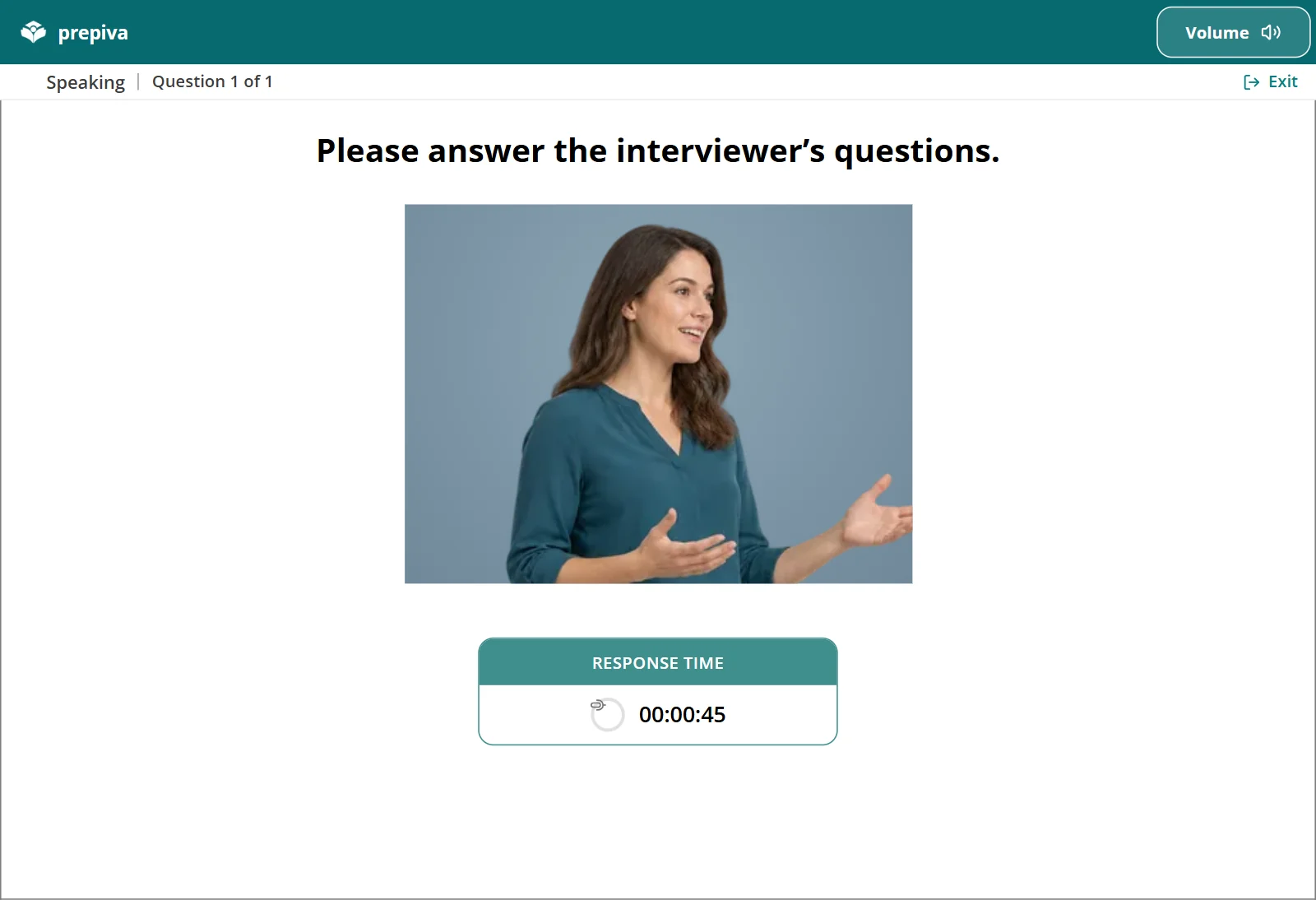
What you hear: a recorded interviewer in a situation such as a research study or a scholarship interview. The interviewer asks four questions on one topic. The first questions are about facts and your own experience; the later ones ask for your opinion on a wider issue. You have 45 seconds for each answer.
Prepiva practice screen
A simple method: point, reason, example.
Point: answer the question directly in your first sentence.
Reason: say why, in one sentence.
Example: give one short, specific example from your life.
Close: finish with one sentence that links back to the question.
Worked answer (new, written for this page)
Interviewer: Some people say students should start classes later in the morning so they can sleep more. Do you agree?
Sample answer (about 45 seconds)
I agree, at least for first-year students. The main reason is that tired students don’t learn much. Last year, my first class started at eight, and I often stayed up late finishing assignments, so I spent most of that lecture just trying to stay awake. I had to study the same material again at night. When my schedule changed and my first class started at ten, I remembered much more and even had time for breakfast. So I think a later start would help students use their class time better, although teachers would need to adjust their schedules too.
The answer gives the point in the first sentence, one reason, one specific example and a closing line. That takes about 45 seconds at a natural pace, so the speaker does not need to rush or fill silence.
Use these original question sets to practice. Each set moves from your own experience to your opinion, like the real task. Set a timer for 45 seconds and answer aloud.
1. Sports and staying active
Tell me about a sport or physical activity you do, or used to do. How did you start?
Think about a time when you tried a new sport or kind of exercise. What was difficult about it?
Some people think schools should give students more time for sports, even if it means fewer hours for other subjects. What is your opinion?
Many people now track their exercise with a phone or a watch. Do you think this helps people stay active? Why or why not?
2. Friends and social life
How did you meet one of your closest friends?
Tell me about a time when a friend helped you with a problem. What happened?
Some people say it is easier to make friends at school than at work. Do you agree? Why?
Do you think friendships that start online can be as close as friendships that start in person? Explain your view.
3. Money and shopping
What is something you bought recently that you are happy with? Why?
Describe a time when you saved money for something important. How did you do it?
Some parents give children a weekly allowance so they learn to manage money. Do you think this is a good idea?
Many shops no longer accept cash. Is this a good change for everyone? Why or why not?
4. Music and the arts
What kind of music do you listen to most, and when do you usually listen to it?
Tell me about a concert, play or exhibition you went to. What do you remember about it?
Should art and music classes be required in high school? Why or why not?
Some people say governments should not spend public money on museums and theaters. What do you think?
5. Saving energy and the environment
What do you do at home to save energy or water?
Tell me about a time when you changed a habit to help the environment. Was it easy?
Some people say individuals can do little for the environment compared with large companies. Do you agree?
Should cities charge drivers a fee to enter the city center on busy days? Explain your view.
6. Sleep and daily routines
Describe a typical morning on a school day or a workday.
Think about a time when you did not get enough sleep before something important. What happened?
Some people say students should start classes later in the morning so they can sleep more. Do you agree?
Is it better to follow the same routine every day or to change it often? Why?
How Speaking is scored
Every answer is scored from 0 to 5 with ETS’s scoring guides.
Listen and Repeat: a 5 is a fully intelligible, exact repetition. Small changes that keep the meaning, such as a missing small word, score lower, and changes to the meaning score lower again.
Take an Interview: the guide looks at whether you answer the question with relevant, well-developed detail, keep a natural conversational pace, speak clearly with helpful rhythm and intonation, and use a range of accurate grammar and vocabulary.
Who scores: ETS scores Speaking with its AI scoring engine, which is trained on human ratings. Human raters help check its accuracy.
Your result: a Speaking band from 1 to 6, in half steps. See how the 1–6 band scale works, with the CEFR level for each band.
On Prepiva, your Speaking rating is an AI-generated practice estimate and is labeled provisional. How we estimate bands explains the method and its limits.
Common mistakes
These traps come from Prepiva’s guides for the two Speaking tasks:
Listen and Repeat: starting too slowly and running out of time on the long sentences; changing the meaning by dropping “not” or a time phrase.
Take an Interview: long silences while you plan a perfect sentence; memorized answers that do not fit the question.
Practice Speaking on Prepiva
Prepiva’s free full practice test, Practice Exam 01, ends with a full Speaking section in the 2026 format. After a free sign-up, its score report includes an AI rating of your Speaking and Writing in that test. Take the full practice test to practice speaking under real timing.
For more Speaking practice with feedback, Prepiva Pro includes Speaking practice sets with AI evaluation, for $19.99 a month or $39.99 for 3 months. To prepare for the section before Speaking, see the Writing section, and for more listening practice, the Listening questions.
How many questions are in the 2026 TOEFL Speaking section?
11: seven Listen and Repeat sentences and four interview questions, in about 8 minutes.
Is there preparation time?
No separate preparation time. You repeat each sentence after a short pause, and you have 45 seconds to answer each interview question, so you plan while you speak.
How long do I speak in the interview?
45 seconds for each of the four answers.
What topics come up in TOEFL Speaking?
Situations from campus and academic life in Listen and Repeat, and interview questions about your experiences and opinions. Practice with the original question sets on this page.
How is TOEFL Speaking scored?
Each answer is scored from 0 to 5 with ETS’s scoring guides, and the section gets a band from 1 to 6, in half steps.
Can I get my Speaking rated for free?
Yes. Prepiva’s free full practice test includes an AI rating of your Speaking and Writing after a free sign-up. The rating is a provisional practice estimate, not an official score.