Skip to content

Free TOEFL iBT® practice test in the 2026 format

Practice Exam 01 is a complete practice test for the TOEFL iBT test in the format ETS introduced on January 21, 2026. You take Reading, Listening, Writing and Speaking in the test’s order, with the number of questions and the section times ETS publishes. At the end you get a score report: a band from 1 to 6 for each section, your overall band and your CEFR level.

The test is free. Every question is written by Prepiva for the 2026 format, and your band is a practice estimate.

Start the free practice test, no sign-up needed

You create a free account on the results screen to see your score report.

By starting, you agree to the Terms of Service and Privacy Policy.

See what Pro adds
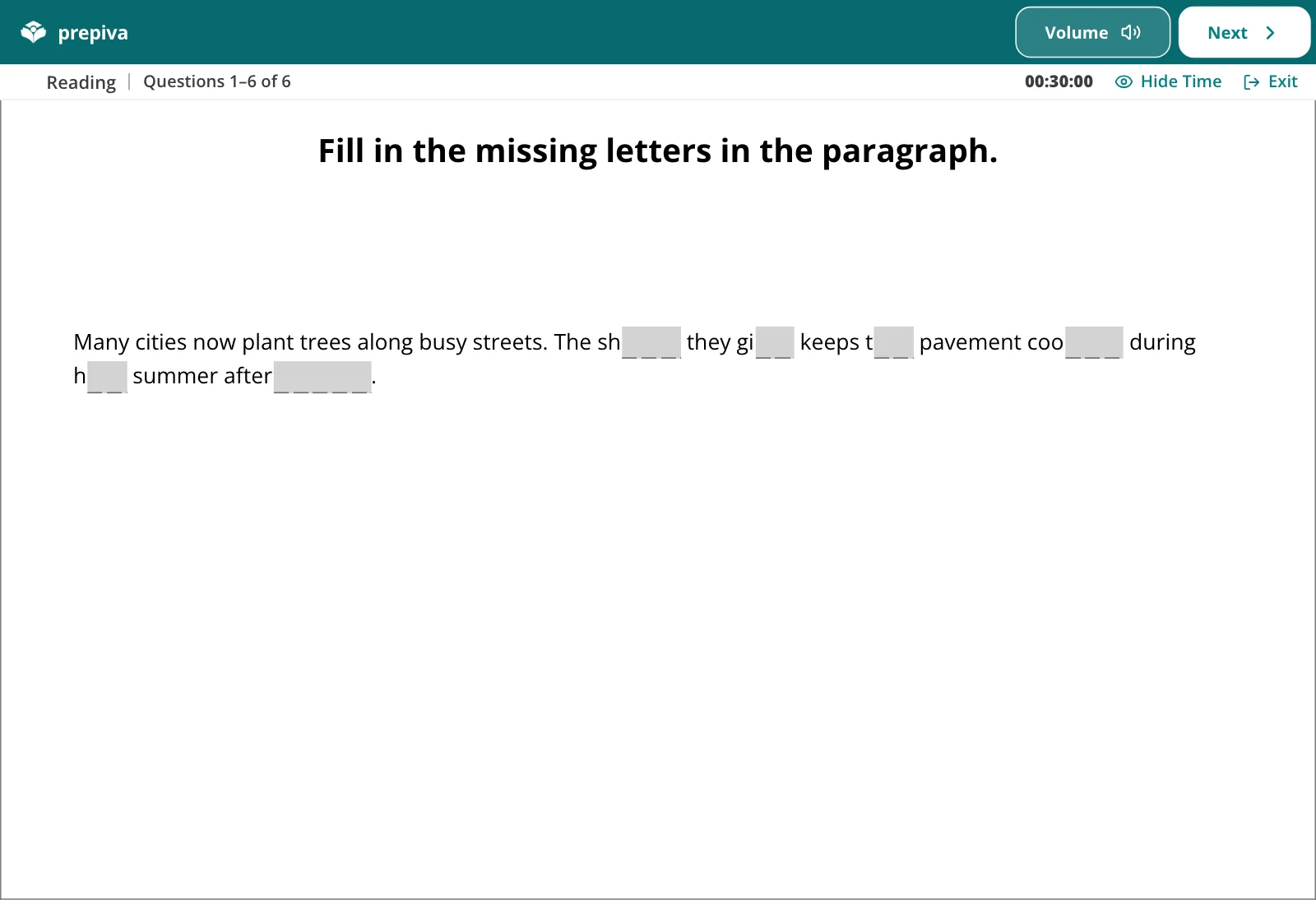
Prepiva practice screen: Reading, Complete the Words
Prepiva practice screen

By the Prepiva team · Last reviewed · How we make and review our content

The free test at a glance

  • Free: one full practice test with its score report
  • No sign-up to start: you create a free account at the end to see your report
  • 4 sections, 120 questions, about 90 minutes of timed work
  • All 12 task types of the 2026 format, with adaptive Reading and Listening
  • The real test’s order and timing; each recording plays once
  • A band from 1 to 6 for each section, an overall band, your CEFR level and the 0–120 comparison
  • AI rating of your Writing and Speaking, with feedback on each answer
  • A review of every question you answered
  • This page in 13 languages, from Español to 日本語; the test itself is in English, as on test day

What is in the free practice test

Practice Exam 01 is a full-length practice test. It has all four sections of the 2026 test, in the same order, with the same number of questions and the same base time for each section.

What is in the free practice test
SectionQuestionsTimeTask typesHow Prepiva scores it
Reading5030 minutesComplete the Words, Read in Daily Life, Read an Academic PassageTwo stages, scored when you finish
Listening4729 minutesListen and Choose a Response, Listen to a Conversation, Listen to an Announcement, Listen to an Academic TalkTwo stages, scored when you finish
Writing1223 minutesBuild a Sentence, Write an Email, Write for an Academic DiscussionBuild a Sentence scored when you finish; the email and the discussion post get a provisional AI rating
Speaking118 minutesListen and Repeat, Take an InterviewProvisional AI rating of your recorded answers

Reading and Listening are adaptive, as they are on the 2026 test. Everyone takes the same first stage. Your answers there decide whether your second stage is easier or harder. Writing and Speaking are the same for everyone.

Each recording plays only once, so keep paper and a pen nearby for notes. In Speaking, you answer out loud and the test records you through your microphone.

To see what the Writing tasks and Speaking tasks ask for, read the sample answers and practice questions on those pages.

Want to see how the whole test is built first? Read how the 2026 test is structured.

Try a few sample questions

These three questions are new and written only for this page. Each one shows a different task type.

Sample 1. Reading: Complete the Words (short example)

In the test, you read a short paragraph. The first sentence is complete. After that, the second half of every second word is missing, and you type the missing letters. Each line (_) stands for one letter. This short example has 6 gaps; in the test, each paragraph has 10.

Many cities now plant trees along busy streets. The sh (3 missing letters) they gi (2 missing letters) keeps t (2 missing letters) pavement coo (3 missing letters) during h (2 missing letters) summer after (5 missing letters).

Show the answers

Answers: shade, give, the, cooler, hot, afternoons.

Why: The first sentence tells you the topic: trees on city streets. “sh___” comes after “The” and is something trees give, so it is a noun: shade. “gi__” is the verb after “they”: give. “coo___” needs a comparison of temperature: cooler. “h__” describes summer: hot. “after_____” with five missing letters is a time of day, plural because the sentence says what usually happens: afternoons.

More Reading questions with all three Reading task types.

Sample 2. Listening: Listen and Choose a Response

In the test, you hear one sentence. It is not printed. Then you choose the best reply from four written options.

Play the recording for sample 2. It plays once.

Which reply is best?

  • A.I’m on the last chapter now.
  • B.The seminar room is on the second floor.
  • C.I read the newspaper every morning.
  • D.Thursday works better for me.
Show the answer

Answer: A.

Script (man): “Have you finished the reading for Thursday’s seminar?”

Why: The question asks whether the reading is finished. A answers it in an indirect, natural way: not yet, but almost. B, C and D repeat words you heard (“seminar”, “reading”, “Thursday”) but do not answer the question. Options that echo the recording are often wrong.

More Listening questions with scripts for all four Listening task types.

Sample 3. Writing: Build a Sentence

In the test, you put groups of words in order to finish a reply. Some items have one group you do not need.

Speaker A: The bookstore on Elm Street closed last month.

Speaker B: Really? Do you know (4 blanks) ?

Word groups:

  • closed
  • did
  • it
  • the owners
  • why
Show the answer

Answer: Really? Do you know why the owners closed it?

Why: A question inside a sentence (“Do you know …”) uses statement order: the subject (“the owners”) comes before the verb (“closed”). “Did” would turn it into a second question, so it is the group you do not need.

Your score report

When you finish, your report shows:

  • a band from 1 to 6 for each section, in half steps (1, 1.5, 2 and so on up to 6);
  • your overall band: the average of the four section bands, rounded to the nearest half band, the same way ETS calculates the overall score;
  • your CEFR level, from A1 to C2;
  • the range your band compares with on the 0–120 scale, which many universities still use in their requirements;
  • a review of every question you answered;
  • for your email and your discussion post, what would raise each score, step by step.

Reading and Listening bands are ready when you finish. Writing and Speaking get a provisional AI rating with short feedback on each answer.

Your bands are practice estimates. They show your level on the same scale ETS uses, but they cannot predict the score ETS will report. Read how the 1–6 bands work and what each band means.

Score report

Example

Practice Exam 01

Overall band

4.5/ 6

CEFR B20–120: 86–94
123456
Reading
5.0
Listening
4.5
Writing
4.0
Speaking
4.5

Illustrative values. Writing and Speaking bands are provisional AI ratings. Practice estimates, not official ETS scores.

How long it takes and what you need

The four sections take about 90 minutes of timed work: 30 minutes for Reading, 29 for Listening, 23 for Writing and 8 for Speaking. Directions and the microphone check are not timed, so plan for about two hours. ETS asks test takers to allow the same for the test itself.

You need:

  • a computer with an up-to-date web browser;
  • headphones or speakers for Listening;
  • a microphone for Speaking (the Speaking section starts with a microphone check);
  • a quiet room, and paper and a pen for notes.

If you have to stop, use Exit to save the test and finish it later.

Free and Pro

Free, $0: one complete practice test, plus unlimited Reading and Listening practice. That is Practice Exam 01 with a full score report, the AI rating of its Writing and Speaking, Reading and Listening section practice and guides for all 12 task types.

Pro, $19.99 a month or $39.99 every 3 months: all 10 full practice tests with retakes, Writing and Speaking practice with AI feedback, scores and feedback on every attempt, and your progress across attempts and sections. From your second full test, Training is built from your own mistakes, down to the plain words you repeat and stronger ones to use. You can cancel anytime.

See what Pro adds

FAQ

Is the TOEFL practice test free?

Yes. You can start Practice Exam 01 without an account. At the end, you create a free account on the results screen to see your score report.

How long is the practice test?

The four sections have about 90 minutes of timed work: Reading 30 minutes, Listening 29, Writing 23 and Speaking 8. With directions and the microphone check, plan for about two hours.

How close is it to the real TOEFL test?

It follows the 2026 format ETS publishes: the same four sections, task types, number of questions and timing, with adaptive Reading and Listening. Every question is original, and your band is a practice estimate.

Where can I practice for the TOEFL iBT test for free?

ETS offers free sample tests on its website. On Prepiva, Practice Exam 01, the Reading and Listening practice sets and the guides for all 12 task types are free.

Can I take the practice test at home?

Yes. Prepiva runs in your web browser, so you can take it anywhere quiet with headphones or speakers and a working microphone.

What feedback do I get on my Writing and Speaking?

Each answer gets an AI rating with short feedback. For the email and the academic discussion post, your report also shows what would raise your score, step by step. With Pro, Training adds the mistakes you repeat across tests, your own sentences fixed, and the plain words you lean on, such as “very” used 10 times, with stronger words to use instead.