TOEFL iBT® Listening questions and practice for the 2026 test
Listening is the second section of the TOEFL iBT test. Since January 21, 2026, it has four task types, from one-line replies to academic talks. Below you can hear a new sample of each task type, answer the questions, and then read the script and the explanation. When you are ready, practice with Prepiva’s free Listening sets.
Questions and time: 47 questions in about 29 minutes. ETS notes that, because the section adapts, the time and the number of questions can vary.
Two stages: everyone takes the same first stage. Your answers there decide whether the second stage is easier or harder. Your score is based on both stages.
Four task types: Listen and Choose a Response, Listen to a Conversation, Listen to an Announcement and Listen to an Academic Talk.
Each recording plays once. You cannot replay it, so take notes while you listen. Note-taking is allowed on test day.
What you see: a picture of the speaker or speakers while the recording plays, then printed questions with four options.
Recordings: from a single short sentence up to a talk of about 250 words, with a mix of accents such as US, Canadian, Australian and British English.
What it tests: whether you understand a short spoken sentence and know what a natural reply sounds like.
What you see: nothing to read at first. You hear one sentence, which is not printed, and then choose the best of four written replies.
Sample (new, written for this page)
Play recording 1: Listen and Choose a Response. It plays once.
Which reply is best?
A.Did you check the pocket of your jacket?
B.My ID number is on the form.
C.Students can find it on the website.
D.I found the library very quiet.
Show the answer
Answer: A.
Why: The speaker has a problem, so a natural reply offers help. A suggests where to look. B, C and D repeat words from the recording (“ID”, “find”, “student”) but do not respond to the problem.
Script (woman): “I can’t find my student ID anywhere.”
What it tests: whether you can follow a short conversation between two people, often on campus, and understand the problem, the information and the solution.
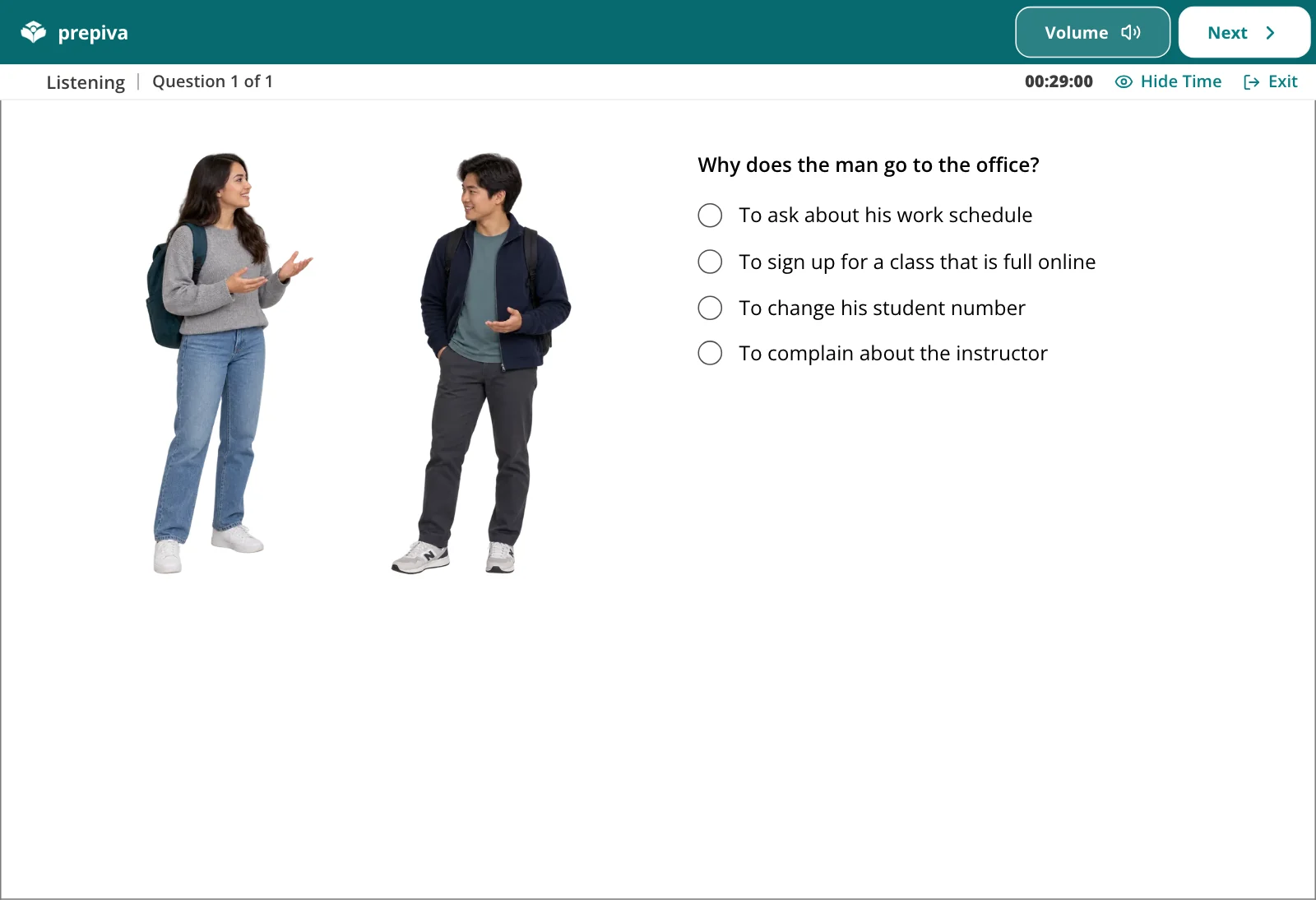
What you see: a picture of the two speakers while the conversation plays, then the questions one at a time.
Sample (new, written for this page)
Play recording 2: Listen to a Conversation. It plays once.
Question 1. Why does the man go to the office?
A.To ask about his work schedule
B.To sign up for a class that is full online
C.To change his student number
D.To complain about the instructor
Question 2. What will the man probably do next?
A.Wait for the website to be updated
B.Give the woman his student number
C.Join the Thursday morning class
D.Ask the instructor for a place
Show the answers
Answers: 1 B, 2 B.
Why: The man explains his purpose in his first line: the class is full on the website. At the end, the woman asks for his student number, so he will probably give it to her. C is wrong because the new section is in the evening, not the morning.
Script:
Man: Hi. I’m trying to register for the photography class, but the website says it’s full.
Woman: Yes, all twenty places were taken this morning. But the instructor just opened a second section on Thursday evenings.
Man: Thursday evenings? I work until six on Thursdays.
Woman: The new section starts at seven, so that should work. You’ll need to sign up here in person, though. The online form hasn’t been updated yet.
Man: OK. Can I do that now?
Woman: Sure. I just need your student number and the course code.
What it tests: whether you can understand a campus or class announcement: what is happening, what has changed, and what listeners should do.
What you see: a picture of the speaker while the announcement plays, then the questions.
Sample (new, written for this page)
Play recording 3: Listen to an Announcement. It plays once.
Question 1. What has changed since last week?
A.The date of the trip
B.The place where the bus leaves
C.The price of museum entry
D.The time of the lecture
Question 2. What should students who cannot go on the trip do?
A.Tell a classmate on the waiting list
B.Email the speaker by Wednesday
C.Return their student card
D.Pay for the bus
Show the answers
Answers: 1 B, 2 B.
Why: “Not from the main gate as I said last week” signals the change: the bus now leaves from the north parking lot. The last sentence tells students who cannot come what to do. Changes of plan and instructions (“Please bring…”, “email me by…”) are the details that announcement questions usually ask about.
Script (woman): Good morning, everyone. Before we start today’s lecture, a quick reminder about the field trip to the science museum next Friday. The bus will leave from the north parking lot at 8:30, not from the main gate as I said last week. Please bring your student card, because the museum gives free entry only to students who show one. Lunch is not included, so bring your own or some money for the café. If you can’t come, email me by Wednesday, so that I can give your seat to someone on the waiting list.
What it tests: whether you can follow part of a lecture: the main idea, the details, why the speaker mentions something, and what the speaker implies.
What you see: a picture of the speaker while the talk plays, then the questions. In Prepiva’s tests, each talk has four questions; this sample shows two.
Sample (new, written for this page)
Play recording 4: Listen to an Academic Talk. It plays once.
Question 1. What is the talk mainly about?
A.How to install air conditioning
B.The benefits and limits of white roofs
C.Why black roofs last longer
D.How winter weather damages roofs
Question 2. Why does the professor mention January?
A.To say when roofs are usually painted
B.To give an example of a time when reflecting sunlight is a disadvantage
C.To explain why the course starts in winter
D.To compare the temperatures of two cities
Show the answers
Answers: 1 B, 2 B.
Why: The talk explains what white roofs do well and where they fall short, so B covers the whole talk; the other options name single details or ideas the talk does not discuss. January is the professor’s example of a cold month, when reflecting sunlight means losing heat that people want.
Script (professor): Today I want to look at a simple idea that some cities use against summer heat: painting roofs white. You probably know that dark surfaces get hot in the sun. A black roof absorbs most of the sunlight that hits it, so it can get much hotter than the air around it. A white roof reflects much of that sunlight back toward the sky. The building underneath stays cooler, and the people inside need less air conditioning. Now, here’s the interesting part. When thousands of buildings do this, a whole neighborhood can become a little cooler, especially at night. But white roofs aren’t perfect. In places with cold winters, a white roof also reflects sunlight in January, when people would actually like that extra heat. So engineers say the idea works best in warm climates, and that a city should look at the whole year, not just the summer.
For a note-taking method and a fully worked talk with its script and sample notes, read the full Academic Talk guide.
Taking notes and other tips
These tips come from Prepiva’s Listening guides:
Note why people are talking. Conversations usually move from a problem to information to a solution. The first question often asks for the purpose.
Listen for changes of plan. Words such as “actually”, “unfortunately” or “not … as I said” often signal the key detail.
Write each example next to its point. “Why does the professor mention X?” asks which point the example supports.
Keep notes short. Key words and arrows are enough. Listening well matters more than writing everything down.
Be careful with echoes. In Listen and Choose a Response, an option that repeats a word you heard often answers a different question.
Check tense and person. A question about the future cannot be answered with a past event.
How Listening is scored
Your Listening score is a band from 1 to 6, in half steps. Each scored question is worth one point. ETS bases the score on the number of questions you answer correctly across both stages and on how difficult those questions are. See how the 1–6 band scale works, with the CEFR level and the comparable 0–120 range for each band.
On Prepiva, your Listening band is a practice estimate. How we estimate bands explains the method and its limits.
Practice Listening free on Prepiva
Prepiva has three Listening practice sets with their own recordings. They are free with a Prepiva account, and after each set you can review your answers. Then take the full practice test to get a band for all four sections, or go back to the Reading questions. Listening skills also help in Speaking, whose first task, Listen and Repeat, asks you to repeat sentences you hear once.
How many questions are in the TOEFL Listening section?
47 questions in about 29 minutes, according to ETS. Because the section adapts, the time and the number of questions can vary. Prepiva’s practice tests use 47 questions in 29 minutes.
Can I replay the audio?
No. Each recording plays once, so take notes while you listen.
What kinds of recordings are there?
Single sentences that need a reply, conversations between two people, campus announcements and academic talks.
Where can I find TOEFL listening practice with scripts?
On this page. Every sample has a recording and its full script, with the answers explained.
Is Prepiva’s Listening practice free?
Yes. The three Listening practice sets, like the Reading sets, are free with a Prepiva account.