
TOEFL iBT® Listen to an Academic Talk: how it works, with an example
Listen to an Academic Talk is the longest recording in the Listening section: part of a lecture or a podcast on an academic subject, followed by four questions. This guide explains the task, the four question types, a note-taking method built on the speaker’s signposts, and one new talk with its script, sample notes and every answer explained. For the whole section, see the Listening practice page.
By the Prepiva team · Last reviewed · How we make and review our content
On this page
What Listen to an Academic Talk is
- What you hear: part of a lecture or a podcast of about 100 to 250 words on a subject such as history, art, life science, physical science, business or social science. Prepiva’s practice talks last about one to one and a half minutes. You do not need background knowledge.
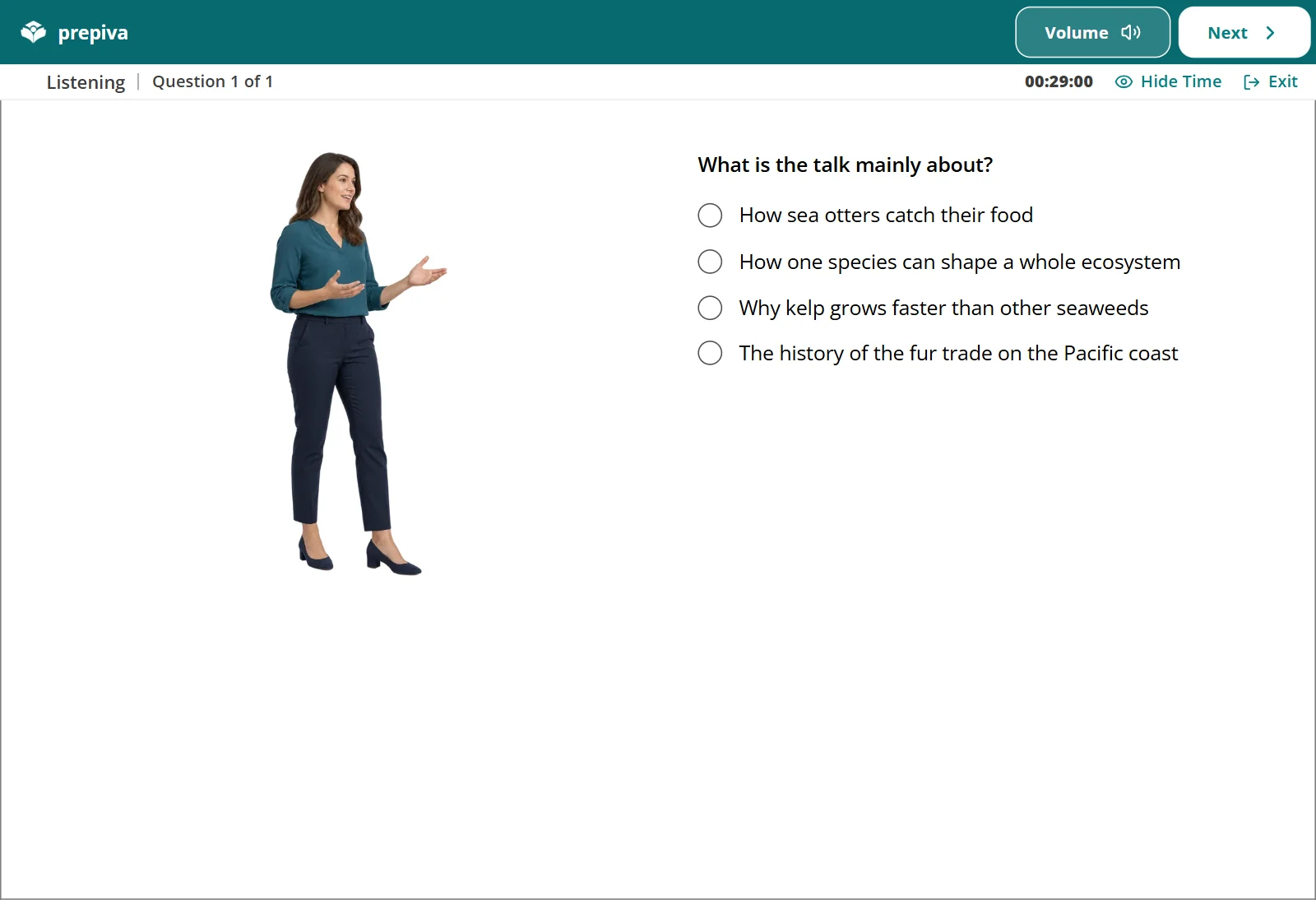
- What you see: a picture of the speaker while the talk plays, then the questions one at a time.
- The questions: four, each with four options.
- How often: the talk plays once. You may take notes.
- Scoring: one point for each correct answer.
The four question types
- Main idea: “What is the talk mainly about?” The answer covers the whole talk, not the example the speaker starts with.
- Detail: “According to the professor, what happened when…?” Your notes should hold the key facts in the order they came.
- Why the speaker mentions something: “Why does the professor mention X?” Ask which point the example supports.
- Inference: “What can be inferred about…?” or “What would probably happen if…?” The answer follows from what the speaker said, one step further.
Notes that work
- Map the structure. Most talks move from an idea to examples, contrasts and a conclusion. Listen for signposts such as “for example”, “now”, “however”, “so” and “the key point is”.
- Write each example next to its point. This answers “why does the speaker mention…” questions almost by itself.
- Use key words and arrows. “otters hunted → urchins up → kelp down” is enough. Listening well matters more than writing everything down.
Worked talk
Listen first if the page has audio, take notes, answer the four questions, then read the script.
Question 1 (main idea). What is the talk mainly about?
- A.How sea otters catch their food
- B.How one species can shape a whole ecosystem
- C.Why kelp grows faster than other seaweeds
- D.The history of the fur trade on the Pacific coast
Question 2 (detail). According to the professor, what happened when sea otters were hunted?
- A.Kelp forests grew larger.
- B.Sea urchin populations increased.
- C.Fish began to eat the urchins.
- D.The otters moved to other coasts.
Question 3 (why mention). Why does the professor mention a stone arch?
- A.To describe a structure found in kelp forests
- B.To explain the meaning of the term “keystone species”
- C.To show how scientists build models of ecosystems
- D.To compare ancient and modern buildings
Question 4 (inference). What would probably happen in an area where sea otters disappeared again?
- A.The kelp forest would probably shrink.
- B.The sea urchins would probably disappear.
- C.The fish would probably eat more kelp.
- D.The water would probably become warmer.
Show the answers
Answers: 1 B, 2 B, 3 B, 4 A.
Script (new, written for this page):
Narrator: Listen to part of a talk in a biology class.
Professor: Today I want to talk about an idea from ecology called a keystone species. In a stone arch, the keystone is the piece at the top that holds the other stones in place. Take it out, and the arch falls down. Some animals play a similar role in their ecosystems. A well-known example is the sea otter on the Pacific coast of North America. Sea otters eat sea urchins, and sea urchins eat kelp, a large seaweed that grows in underwater forests. Those forests give food and shelter to many kinds of fish. Now, when sea otters were hunted for their fur, they almost disappeared, and urchin populations grew quickly. In many places, the urchins ate so much kelp that the forests disappeared too, and so did many of the fish that lived in them. Where otters have returned, urchin numbers have dropped, and the kelp has often grown back. So the otters don’t eat kelp at all, but they protect it. And that’s the key point: a keystone species has a much bigger effect on its ecosystem than its numbers alone would suggest.
keystone species = big effect > its numbers
  arch: keystone holds stones; remove -> falls
ex: sea otter (Pacific coast, N. Am.)
  otter eats urchins; urchins eat kelp (underwater forest)
  otters hunted (fur) -> urchins UP -> kelp DOWN -> fish DOWN
  otters back -> urchins DOWN -> kelp UP
KEY PT: otters protect kelp w/o eating it
Why each answer is right
- B. The professor introduces the idea of a keystone species and uses the otter to show it. A and D describe parts of the example, not the talk; C is never discussed.
- B. “When sea otters were hunted for their fur, … urchin populations grew quickly.” A is the opposite of what happened.
- B. The arch comes right after the term and explains it: remove the keystone and the structure falls. The professor uses it as a comparison, not as part of the ocean.
- A. The talk says that without otters the urchins ate the kelp, and that the kelp grew back when otters returned. If otters disappeared again, the same chain would probably shrink the forest. B is the reverse of the chain.
Common traps
- Main-idea options that describe only the opening example. In this talk, the arch and the fur trade are details; the main idea is the keystone species.
- Details mentioned as a contrast or a misconception. When a speaker says “you might think… but”, the first part is usually not the answer.
- Writing too much. If you write full sentences, you miss the next point. Key words and arrows are enough.
How to practice
- Listen to one short academic talk or podcast a day, two to three minutes long.
- Take notes from the signposts only, then say the main idea in one sentence.
- Check your notes against the script when there is one, and notice what you missed: usually an example or a contrast.
Practice on Prepiva
Prepiva’s three Listening practice sets include academic talks with their own recordings and questions. They are free with a Prepiva account, and after each set you can review your answers. Then take the full practice test to get a band for all four sections, or learn the other Listening tasks: Listen and Choose a Response, Listen to a Conversation and Listen to an Announcement.
FAQ
How long is the academic talk?
About 100 to 250 words. Prepiva’s practice talks last about one to one and a half minutes.
How many questions follow?
Four, each with four options.
Can I take notes?
Yes. Note-taking is allowed. Keep your notes short: key words and arrows.
Can I replay the talk?
No. It plays once.
What does “Why does the speaker mention…” ask?
Which point the example supports. Write each example next to its point in your notes.