Skip to content

TOEFL iBT® Listen to a Conversation: how it works, with examples

In Listen to a Conversation, you hear two people talk about something from campus or everyday life and then answer two questions. The questions test more than the words: why the people are talking, what a speaker means but does not say, and what will probably happen next. This guide explains the five kinds of questions and walks through three new conversations with their scripts. For the whole section, see the Listening practice page.

By the Prepiva team · Last reviewed · How we make and review our content

On this page

What Listen to a Conversation is

  • What you hear: a short conversation between two speakers, mostly about campus life, on topics such as dining, services, health, hobbies, shopping and travel. A picture of the two speakers is on the screen.
  • What you do: answer two questions, one at a time, each with four options.
  • How often: the recording plays once. You can take notes while you listen.
  • How long: short. ETS gives no fixed length; its own sample conversation has about 80 words, well under a minute.
  • How much it counts: in ETS’s 2026 blueprint, conversations provide 10 of the 47 Listening items.
  • Scoring: one point for each correct answer.
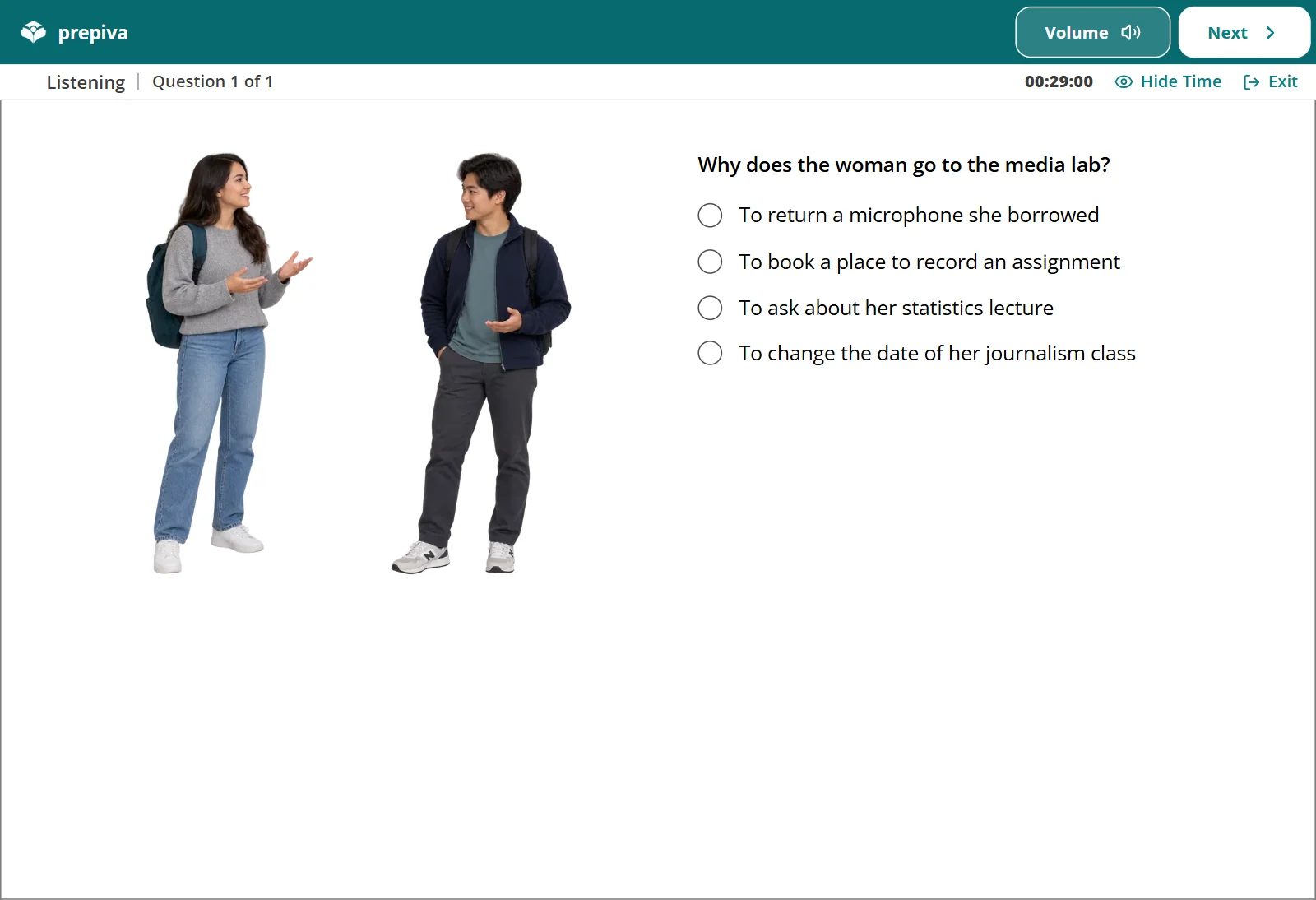
Prepiva practice screen: Listening, Listen to a Conversation, with a question and four options
Prepiva practice screen

What the two questions ask

ETS lists the skills these questions test. In practice they come in five kinds:

What the two questions ask
Question kindTypical wordingWhere the answer usually is
Main idea or purpose“Why does the woman go to the office?” “What are the speakers mainly discussing?”The first one or two lines, where the problem or request appears
Detail“When does the course meet?” “What does the man need to bring?”A time, place, number or condition, often one that replaces an earlier one
Implied meaning“What does the man imply when he says…?”A polite refusal, a hesitation or a joke: what the speaker means, not the literal words
Purpose of a remark“Why does the woman mention…?”The line just before or after the remark
Prediction“What will the man probably do next?”The last one or two lines: a decision, an offer or an agreement

How campus conversations are built

Most conversations follow the same path: a problem or a question, some information, then a decision. Three signals carry the points that questions ask about:

  • Changes: “Actually…”, “Unfortunately…” and “In that case…” introduce the detail that matters.
  • Hedges: “I’m not sure that works for me” and “I guess…” carry implied meaning.
  • Offers near the end: “Shall I…?” and “Then let’s…” usually answer the prediction question.

Three worked conversations

In the test you only hear the conversation. Here the script is printed so that you can study it. If the page has audio, listen first, answer the questions, and read the script afterwards.

Conversation 1: at the media lab (main idea, prediction)

Script:

Woman: Hi. I need to record a podcast episode for my journalism class. Can I book one of the sound booths for Thursday?

Man: Thursday’s fully booked, I’m afraid. Everyone’s recording their midterm projects. But Booth B is free tomorrow morning, from nine to eleven.

Woman: Tomorrow morning… I have a statistics lecture at ten.

Man: Well, a recording usually takes less than an hour if you’ve practiced your script.

Woman: That’s true. I’ve practiced mine twice already.

Man: Then you’d be finished before your lecture. Shall I put your name down for nine?

Woman: Yes, please. Do I need to bring my own microphone?

Man: No, the booths have everything you need.

Question 1. Why does the woman go to the media lab?

  • A.To return a microphone she borrowed
  • B.To book a place to record an assignment
  • C.To ask about her statistics lecture
  • D.To change the date of her journalism class

Question 2. What will the woman probably do tomorrow morning?

  • A.Practice her script for the first time
  • B.Buy a new microphone
  • C.Record her podcast before her lecture
  • D.Go to her journalism class
Show the answers

Answers: 1 B, 2 C. Her first line states the purpose: a sound booth for a class project. She accepts the man’s offer of nine o’clock tomorrow, which answers the prediction question. She has already practiced twice, and the booths have microphones.

Conversation 2: the first-aid course (implied meaning, detail)

Script:

Man: Did you sign up for the first-aid course at the health center?

Woman: I meant to, but the Saturday session was full by the time I got there.

Man: There’s a Wednesday evening session too, from six to nine.

Woman: Wednesday evening… that’s when my choir rehearses.

Man: Oh. The course only runs twice this term, though.

Woman: Hmm. Well, I guess the choir can sing without me for one week. Our concert isn’t until December.

Man: Great. Then let’s go together. I’m taking the Wednesday one too.

Question 1. What does the woman imply when she says, “I guess the choir can sing without me for one week”?

  • A.She plans to leave the choir.
  • B.She will miss one rehearsal to take the course.
  • C.The choir’s concert has been canceled.
  • D.She thinks the course is too long.

Question 2. When does the Wednesday session take place?

  • A.On Saturday morning
  • B.Before the choir rehearsal
  • C.From six to nine in the evening
  • D.In December
Show the answers

Answers: 1 B, 2 C. The woman never says “I’ll take the Wednesday session”, but the man’s reply, “Then let’s go together”, confirms that she means it. The time is said once, early on, so notes on days and times pay off. December is the date of the concert, not of the course.

Conversation 3: at the dining hall (purpose of a remark, prediction)

Script:

Woman: Excuse me, are you the manager? I have a question about the salad bar.

Man: I am. How can I help?

Woman: I’m allergic to nuts, and the signs on the salad bar don’t list the ingredients anymore.

Man: Ah, yes. We took the old signs down because they were too small to read. The new ones will be up by Friday.

Woman: So until then, how do I know what’s safe to eat?

Man: Ask any of the cooks. They keep the full ingredient list at the counter. And the stir-fry station doesn’t use nuts at all.

Woman: Oh, that’s good to know. I’ll start there, then.

Question 1. Why does the man mention that the old signs were too small to read?

  • A.To apologize for the price of the food
  • B.To explain why the signs were removed
  • C.To suggest that the woman should read more carefully
  • D.To complain about the company that printed them

Question 2. What will the woman probably do?

  • A.Get her food at the stir-fry station
  • B.Print new signs for the salad bar
  • C.Ask the manager to change the menu
  • D.Stop eating at the dining hall
Show the answers

Answers: 1 B, 2 A. The remark about small signs explains why the ingredients are missing: a purpose question asks what a remark does in the conversation. Her last line, “I’ll start there”, refers to the stir-fry station, which does not use nuts.

Taking notes when you hear it once

ETS allows note-taking: scratch paper and a pencil at a test center, a whiteboard or paper inside a transparent sheet protector at home. Keep notes short: two columns, one per speaker; the problem in a few words; changes with an arrow (“Sat full → Wed 6–9”); the last decision. Five or six words per conversation are enough. Hearing everything matters more than writing everything.

Common traps

  • A detail that was corrected. The first plan is often replaced, as Thursday was in conversation 1.
  • An answer that sounds sensible but was not said. Choose from what the speakers said, not from what people usually do.
  • The right fact for the wrong speaker, or an option that repeats words from the recording but answers a different question.

How to practice

  • Listen to short dialogues every day: podcasts with two hosts, campus videos or scenes from a series.
  • After each one, say aloud why the people were talking and what will happen next.
  • Answer from listening first, then read a script to find what you missed.

Practice on Prepiva

Each of Prepiva’s three Listening practice sets includes a conversation with its own recording and questions. The sets are free with a Prepiva account, and after each one you can review your answers. Then take the full practice test to get a band for all four sections, or learn the other Listening tasks: Listen to an Announcement, Listen and Choose a Response and Listen to an Academic Talk.

FAQ

How long is the conversation?

Short. ETS gives no fixed length; its own sample conversation has about 80 words, well under a minute.

How many questions follow each conversation?

Two, one at a time, each with four options.

Can I take notes?

Yes. ETS allows note-taking: scratch paper at a test center, and a whiteboard or paper in a transparent sheet protector at home.

Can I hear the conversation again?

No. The recording plays once.

How is it scored?

One point for each correct answer.