
TOEFL iBT® Listen and Choose a Response: how it works, with examples
Listen and Choose a Response is the shortest task in the Listening section: you hear one sentence and choose the most natural reply. It looks easy, but the wrong options are built to catch people who listen for words instead of meaning. This guide gives you a method based on what the speaker is doing, six new worked items and the traps to avoid. For the whole section, see the Listening practice page.
By the Prepiva team · Last reviewed · How we make and review our content
On this page
What Listen and Choose a Response is
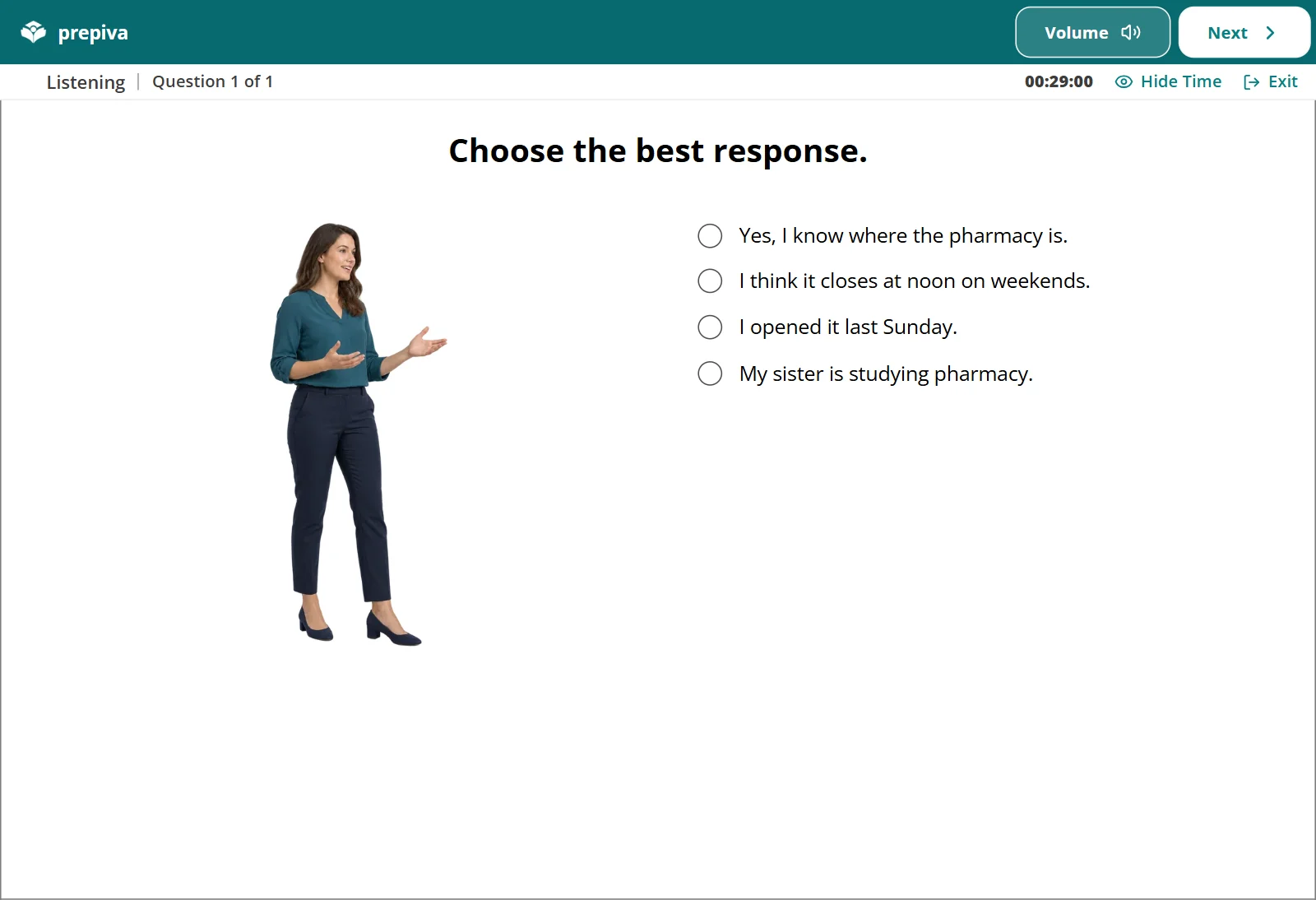
- What you hear: one short question or statement on an everyday or campus topic, the first half of a short exchange. It is not printed on the screen.
- What you do: read four written replies and choose the most appropriate one.
- How often: the recording plays once.
- How much it counts: in ETS’s 2026 blueprint, it provides 15 to 19 of the 47 Listening items, so you will answer many of these short questions.
- Time: answer within a few seconds and move on.
- Scoring: one point for each correct answer.
Name the function first
Before you look at the options, ask what the speaker is doing. Each function has its own kind of natural reply:
| The speaker is… | A natural reply… |
|---|---|
| asking a question | answers it, often indirectly |
| making a request | agrees, refuses politely or asks for details |
| making an offer or an invitation | accepts, or refuses politely with a reason |
| complaining about a problem | shows sympathy or suggests a solution |
| showing surprise | confirms or explains |
| giving an opinion | agrees or disagrees, usually with a reason |
Expect indirect answers
Natural replies often answer the need behind the words, not the words themselves. Asked “Do you know when the lab opens?”, a person might say “Check the sign by the door.” That reply never gives a time, but it is a natural answer. The test uses this often: the right option can sound unexpected, while the wrong options repeat words you just heard.
Six worked items
In the test you only hear the sentence. Here it is printed so that you can study it; if the page has audio, listen first and read afterwards.
1. A question
Woman: “Do you know if the campus pharmacy is open on Sundays?”
- A.Yes, I know where the pharmacy is.
- B.I think it closes at noon on weekends.
- C.I opened it last Sunday.
- D.My sister is studying pharmacy.
Show the answer
Answer: B. The real question is whether the pharmacy is open, and B answers it with the hours. A answers “Do you know” literally but about the place, not the day. C and D repeat “open”, “Sunday” and “pharmacy”.
2. A request
Man: “Would you mind speaking a little more slowly? I’m trying to take notes.”
- A.Sorry, of course. I’ll slow down.
- B.I don’t mind which notes you take.
- C.Yes, it was a slow afternoon.
- D.I took notes in the last class.
Show the answer
Answer: A. “Would you mind…?” is a polite request, and “Of course” agrees to it. B repeats “mind” and “notes”, C repeats “slow”, and D talks about a different class.
3. An invitation
Woman: “A few of us are trying the new climbing wall on Friday. Do you want to come along?”
- A.The wall was painted on Friday.
- B.I’d love to, but I have a shift at the café.
- C.Yes, I came along the river path.
- D.They climbed it in two hours.
Show the answer
Answer: B. A polite refusal with a reason is a natural reply to an invitation. A, C and D repeat “wall”, “Friday”, “come along” and “climbing” without answering the invitation.
4. A complaint
Man: “The new ticket app keeps logging me out.”
- A.Have you tried updating it?
- B.I bought my ticket at the station.
- C.Keep it in your pocket.
- D.I’ll log the hours for you.
Show the answer
Answer: A. A complaint invites sympathy or a solution, and A suggests one. B repeats “ticket”, C repeats “keep”, and D repeats “log” with a different meaning.
5. Surprise
Woman: “Wait, you’ve already finished the whole report?”
- A.Yes, I started it last weekend.
- B.I’ll finish my coffee first.
- C.The report is on page twelve.
- D.Wait for me by the door.
Show the answer
Answer: A. The speaker is surprised at how fast the work was done, and A confirms it and explains why. Notice the person: “you’ve finished” needs an answer about “I”. B, C and D repeat “finish”, “report” and “wait”.
6. An opinion
Man: “I think online classes are just as good as classes on campus.”
- A.Really? I find it harder to ask questions online.
- B.The campus has two libraries.
- C.Online classes start next week.
- D.It’s as good as new.
Show the answer
Answer: A. An opinion invites agreement or disagreement, and A disagrees politely with a reason. B, C and D repeat “campus”, “online classes” and “as good as”.
Common traps
- Echo words. An option that repeats a word from the recording often answers a different question. In all six items above, wrong options repeat words you heard.
- The wrong time or person. A question about the future cannot be answered with a past event, and “Did you…?” needs an answer about “I”.
- Over-thinking. Each item is short, and there are many of them. Choose, then move on.
How to practice
- Listen to short everyday exchanges every day: podcasts with conversation, campus videos, or friends talking.
- Before you choose, say the function aloud: “request”, “complaint”, “invitation”. It trains you to listen for purpose.
- Collect polite formulas: “Would you mind…?”, “Do you want to…?”, “I’d love to, but…”. Many items depend on them.
Practice on Prepiva
Prepiva’s three Listening practice sets include Listen and Choose a Response items with their own recordings. They are free with a Prepiva account, and after each set you can review your answers. Then take the full practice test to get a band for all four sections, or learn the other Listening tasks: Listen to a Conversation, Listen to an Announcement and Listen to an Academic Talk.
FAQ
Is the sentence shown on screen?
No. You only hear it, once, and then read four written replies.
How fast must I answer?
Within a few seconds. The items are short, and there are many of them in the Listening section.
Can I go back to a Listening question?
On Prepiva’s practice tests, no: you answer each question before you move on. On the real test, you cannot go back between the two stages of the Listening section.
Why is the best reply sometimes indirect?
Natural speech often answers the need behind a question rather than its exact words, and this task tests whether you understand that.
How is it scored?
One point for each correct answer.