Skip to content

TOEFL iBT® Writing sample answers for the 2026 test

Writing is the third section of the TOEFL iBT test, after Reading and Listening. Since January 21, 2026, it has three tasks: Build a Sentence, Write an Email and Write for an Academic Discussion. On this page you will find a new prompt and a sample answer for each task, with notes on what makes each answer work, and an explanation of how the section is scored. When you want feedback on your own writing, Prepiva’s free full practice test rates your Writing.

By the Prepiva team · Last reviewed · How we make and review our content

On this page

The Writing section at a glance

  • Questions and time: 12 questions in about 23 minutes, according to ETS.
  • Three tasks:
    • Build a Sentence: 10 short items;
    • Write an Email: 1 task, 7 minutes;
    • Write for an Academic Discussion: 1 task, 10 minutes.

    That leaves about 6 minutes for the ten Build a Sentence items.

  • Not adaptive: everyone who takes the same version of the test gets the same Writing tasks.
  • You type your answers. ETS’s topics do not require special background knowledge.

If you studied with older materials, note one change: the integrated essay, where you read a passage and heard a lecture before writing, is not one of the 2026 tasks. See the full test format for all four sections.

Build a Sentence

What it tests: your command of English sentence structure.

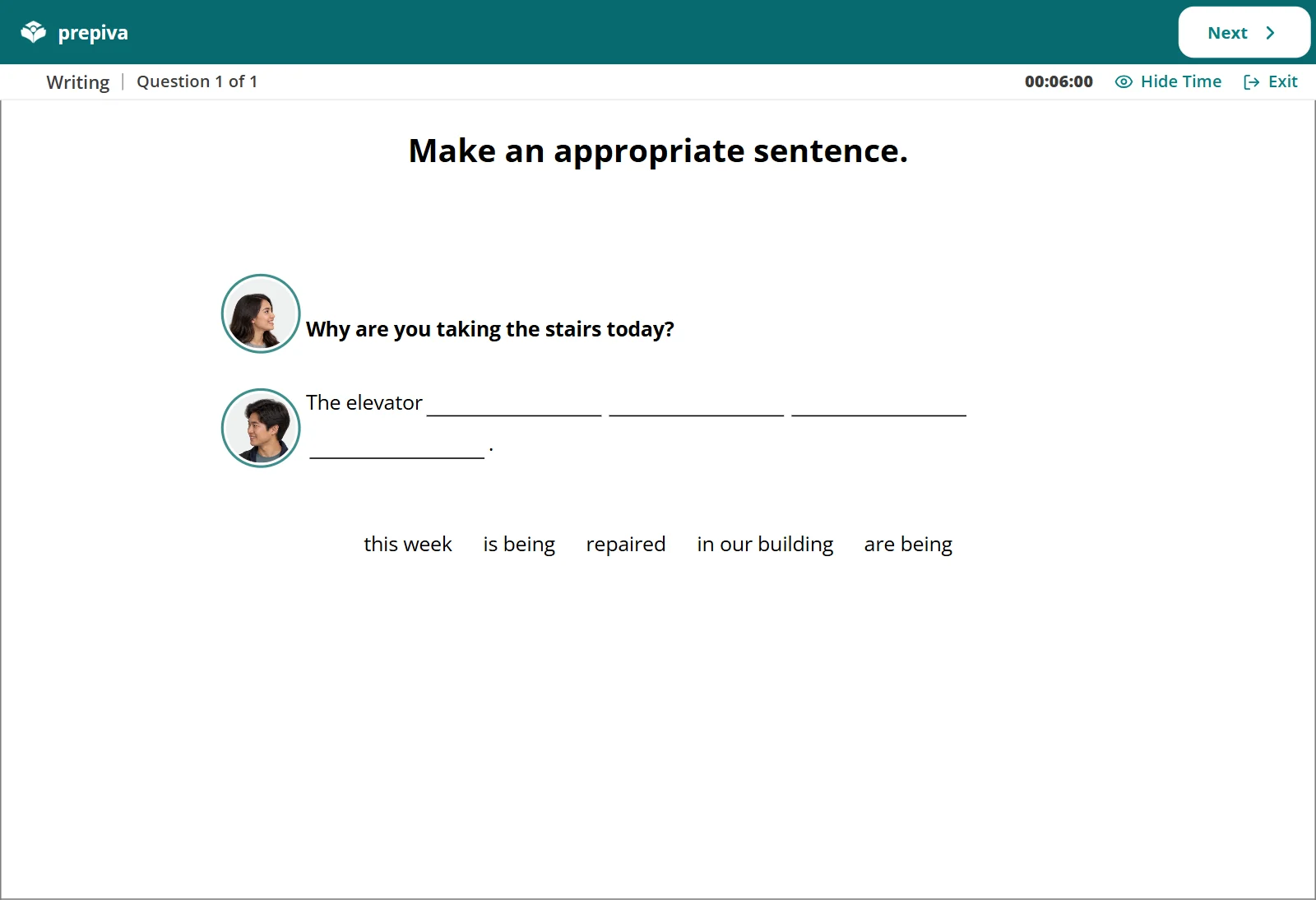
What you see: a short exchange between two people. The first line is complete. The reply has blanks and a set of word groups in the wrong order, and you place the groups to make a correct reply. Some items include one group you do not need.

Prepiva practice screen: Writing, Build a Sentence, with word groups to place in a reply
Prepiva practice screen

Sample (new, written for this page)

Speaker 1: Why are you taking the stairs today?

Speaker 2: The elevator (4 blanks) .

Word groups:

  • this week
  • is being
  • repaired
  • in our building
  • are being
Show the answer

Answer: The elevator in our building is being repaired this week.

Why this order works:

  1. Find the subject and the verb first. The core of the reply is “The elevator … is being repaired”.
  2. Let agreement choose between similar groups. “elevator” is singular, so the verb is “is being”. “are being” is the group left over.
  3. Keep each phrase next to what it describes. “in our building” describes the elevator, so it follows “elevator”. The time phrase “this week” goes at the end, never inside the verb.
  4. Look at the end punctuation. A period means a statement, so the subject comes before the verb. A question mark would mean question order, except inside phrases such as “Do you know when it opens?”, where the question inside the sentence keeps statement order.
With about 6 minutes for ten items, give each one about 30 seconds and move on when you are stuck.

Eight patterns, each with a worked item, are in the full Build a Sentence guide.

Write an Email

What it tests: whether you can write a clear, polite message for a real academic or social situation, for example to make a recommendation, extend an invitation or propose a solution.

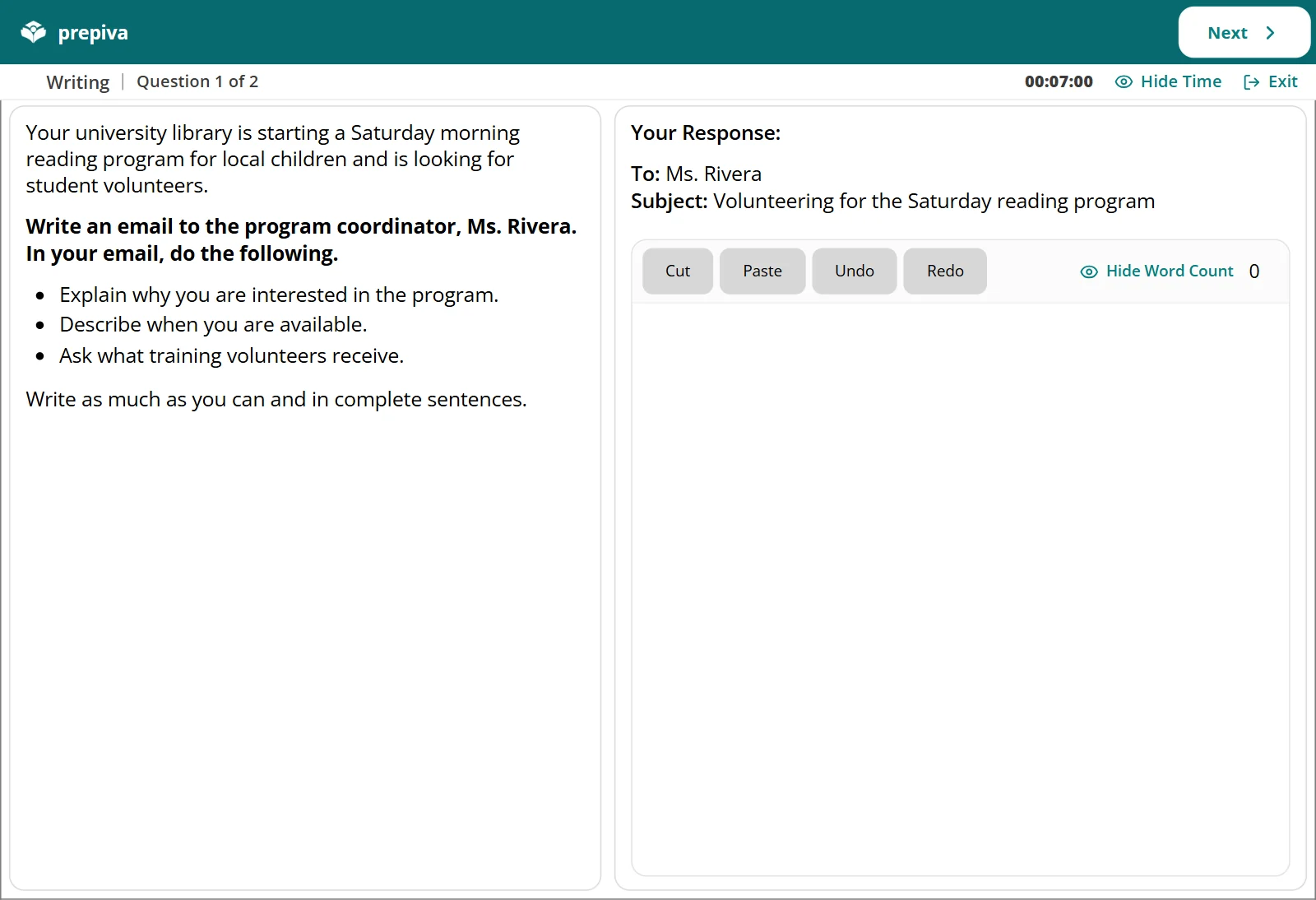
What you see: a short situation and a list of things your email must do. The To and Subject lines are already filled in. You have 7 minutes.

Prepiva practice screen: Writing, Write an Email, with the task on the left and the email editor on the right
Prepiva practice screen

Sample situation (new, written for this page)

Your university library is starting a Saturday morning reading program for local children and is looking for student volunteers.

Write an email to the program coordinator, Ms. Rivera. In your email, do the following:

  • Explain why you are interested in the program.
  • Describe when you are available.
  • Ask what training volunteers receive.

To: Ms. Rivera · Subject: Volunteering for the Saturday reading program

Sample email (139 words)

Dear Ms. Rivera,

I saw the library’s notice about the Saturday reading program, and I would like to volunteer. When I was a child, my older cousin read with me every weekend, and that is how I started to love books. I would be glad to do the same for younger children. As an education student, I would also gain useful experience.

I am free every Saturday from 9 a.m. to noon. During the exam period in December, I may need to miss one or two Saturdays, but I would tell you at least a week in advance.

Could you tell me what training volunteers receive before the program starts? For example, will there be a session on choosing books for different ages?

Thank you for your time. I look forward to hearing from you.

Best regards,
Ana Costa

What makes it work:

  • Every point is covered, one short paragraph each, in the order the task gives them.
  • The tone fits the reader: a polite greeting, the purpose in the first sentence, thanks and a closing.
  • Concrete details make it real: a personal reason, exact times, a planned absence and a specific question about training.
  • The sentences are simple and accurate, which leaves a minute to check grammar and spelling.

For what the scoring guide rewards, a 7-minute plan and a second situation to practice, read the full Write an Email guide.

Write for an Academic Discussion

What it tests: whether you can state and support an opinion in an online class discussion, respond to other people’s ideas and write in an academic tone.

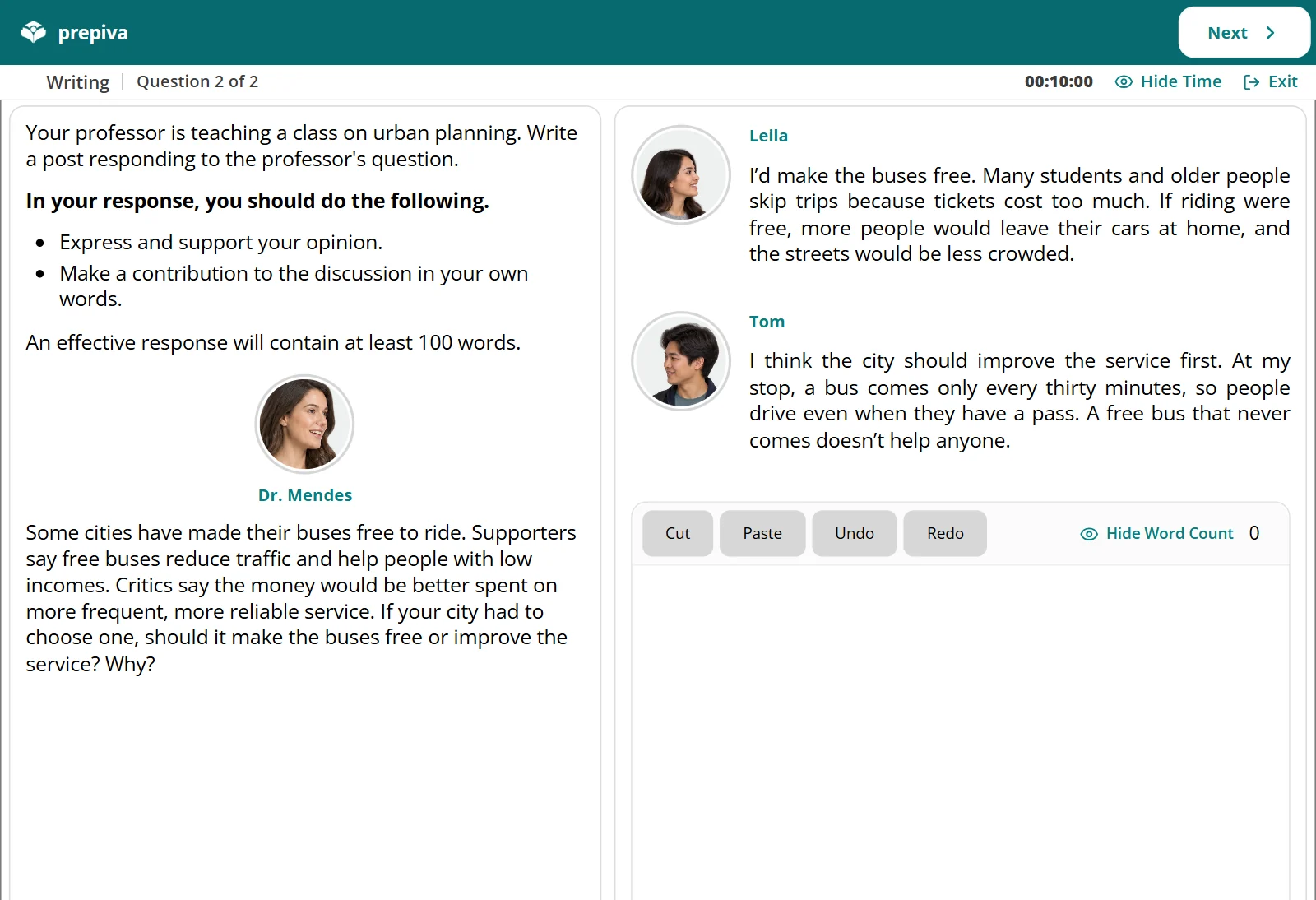
What you see: a post from a professor that introduces a topic and asks a question, and short posts from two students with different views. You write your own post in 10 minutes. ETS’s directions say that an effective response contains at least 100 words. Prepiva’s guide suggests 120 to 150 words, enough to develop one idea and still check your work.

Prepiva practice screen: Writing, Write for an Academic Discussion, with a professor’s question and two student posts
Prepiva practice screen

Sample prompt (new, written for this page)

Your professor is teaching a class on urban planning. Write a post that responds to the professor’s question. Give and support your opinion in your own words.

Dr. Mendes: Some cities have made their buses free to ride. Supporters say free buses reduce traffic and help people with low incomes. Critics say the money would be better spent on more frequent, more reliable service. If your city had to choose one, should it make the buses free or improve the service? Why?

Leila: I’d make the buses free. Many students and older people skip trips because tickets cost too much. If riding were free, more people would leave their cars at home, and the streets would be less crowded.

Tom: I think the city should improve the service first. At my stop, a bus comes only every thirty minutes, so people drive even when they have a pass. A free bus that never comes doesn’t help anyone.

Sample post (131 words)

I agree with Tom that reliable service matters most, but I would add a reason that neither post mentions: free buses can make the service worse. If fares disappear, the city loses money that it could use to run more buses, and if many new riders appear at once, the buses become crowded and slow. In my hometown, the city added a bus every ten minutes on the main route instead of cutting prices, and within a year the buses were full, because people could finally count on them. Once the service is frequent, the city could make rides free for the groups that need help most, such as students and older residents. That way, it would support people with low incomes without losing the money that keeps the buses running.

What makes it work:

  • The first sentence gives a clear position and connects it to a classmate.
  • It adds a new reason, the loss of fare money, that neither student raised.
  • One specific example supports the reason, instead of several vague ones.
  • It ends with a practical idea that answers Leila’s concern, so it contributes to the discussion rather than repeating it.

For five ways to add a new idea and another annotated sample post, read the full Academic Discussion guide.

How Writing is scored

  • Build a Sentence: each item is right or wrong, worth one point.
  • The email and the discussion post: each is scored from 0 to 5 with ETS’s scoring guides.
    • For the email, the guide looks at how well your details support the purpose of the message, the variety and precision of your sentences and words, social conventions such as politeness and register, and the number of errors.
    • For the discussion post, it looks at relevant, well-developed explanations, examples or details, a variety of sentence structures, precise word choice and the number of errors.
  • Who scores: ETS scores the email and the discussion post with its AI scoring engine, which is trained on human ratings. Human raters help check its accuracy.
  • Your result: a Writing band from 1 to 6, in half steps. Your overall band is the average of your four section bands, rounded to the nearest half band. See how the 1–6 band scale works, with the CEFR level for each band.

On Prepiva, your Writing rating is an AI-generated practice estimate and is labeled provisional. How we estimate bands explains the method and its limits.

Common mistakes

These traps come from Prepiva’s guides for the three Writing tasks:

  • Write an Email: a long introduction that leaves no time for the third point; text-message style with a formal reader such as a professor or a manager.
  • Write for an Academic Discussion: summarizing the other posts instead of giving your own view; repeating a classmate’s reason in different words.
  • Build a Sentence: putting a time phrase in the middle of the verb; forgetting “do”, “does” or “did” in a direct question.

Get your Writing rated

Prepiva’s free full practice test, Practice Exam 01, has all four sections in the 2026 format. After a free sign-up, its score report includes an AI rating of your Writing and Speaking in that test. For the email and the discussion post, it also shows what would raise each score, step by step. Take the full practice test when you want to see how the three tasks feel under time.

For more Writing practice with feedback, Prepiva Pro includes Writing practice sets with AI evaluation, for $19.99 a month or $39.99 for 3 months. Next, see the Speaking questions and topics for the last section of the test.

FAQ

What are the Writing tasks on the 2026 TOEFL iBT test?

Build a Sentence, Write an Email and Write for an Academic Discussion: 12 questions in about 23 minutes.

Is there still an integrated essay?

No. Since January 21, 2026, the Writing section has the three tasks above. The integrated essay, based on a reading and a lecture, belonged to the earlier version of the test.

How many words should my academic discussion post have?

ETS’s directions say that an effective response contains at least 100 words. About 120 to 150 words gives you room to develop one idea and still check your work.

How long do I have to write the email?

7 minutes. The academic discussion post has 10 minutes.

How is TOEFL Writing scored?

Each Build a Sentence item is right or wrong. The email and the discussion post are each scored from 0 to 5 with ETS’s scoring guides. The section result is a band from 1 to 6, in half steps.

Can I get my Writing rated for free?

Yes. Prepiva’s free full practice test includes an AI rating of your Writing and Speaking after a free sign-up. The rating is a provisional practice estimate, not an official score.