Skip to content

TOEFL iBT® Write an Email: how it works, with a sample

Write an Email is the second Writing task: you read a short situation and write an email that does three things, in 7 minutes. Strong emails are not long or fancy. They answer every point with a concrete detail, in a tone that fits the reader. This guide explains what the scoring guide rewards, gives you a 7-minute plan, and walks through an original sample email, with a second situation for you to try. For sample answers to all three Writing tasks, see the Writing sample answers page.

By the Prepiva team · Last reviewed · How we make and review our content

On this page

What Write an Email is

  • What you see: a short situation from academic or social life, the person to write to, and a list of things your email must do. The To and Subject lines are already filled in.
  • Why you write: to reach a goal, such as making a request, giving information, recommending something, extending an invitation or proposing a solution to a problem.
  • Time: 7 minutes. You type your email in an editor on the screen.
  • Scoring: from 0 to 5, with ETS’s scoring guide.
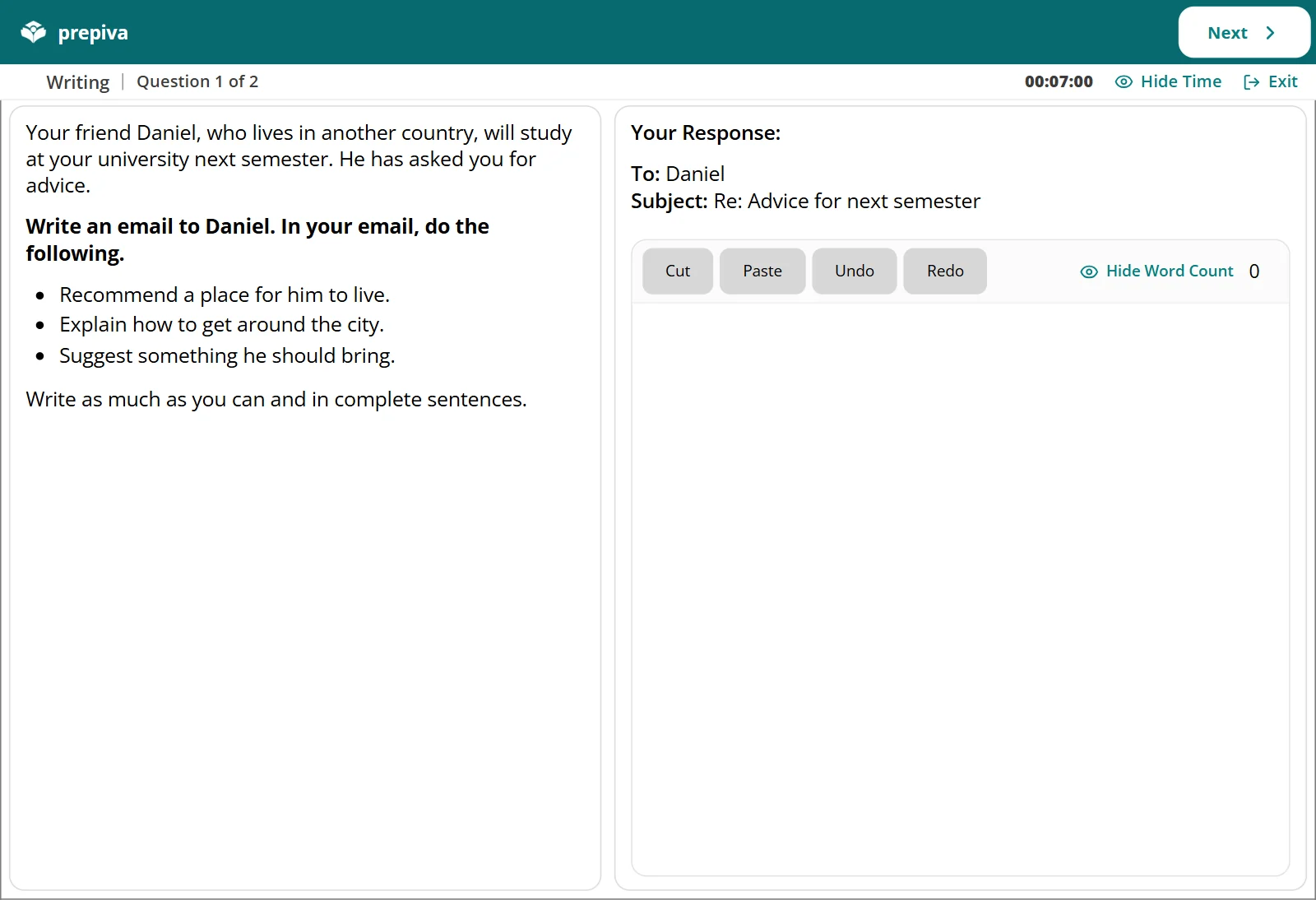
Prepiva practice screen: Writing, Write an Email, with the task on the left and the email editor on the right
Prepiva practice screen

What the scoring guide rewards

ETS’s scoring guide describes a top email (a 5) as fully successful. In plain words, it has:

  • Details that serve the purpose: each point is explained with something specific, such as a reason, a time or an example.
  • Varied, precise language: different kinds of sentences and the right word for the situation.
  • Fitting social conventions: a polite tone at the right level of formality, information in a clear order, and requests or refusals phrased the way people really phrase them.
  • Almost no errors, other than the slips anyone makes under time, such as a typo.

A middle score (a 3) means the email does the task in part: some points are thin, the range of language is narrower, and errors are noticeable. ETS scores the email with its AI scoring engine, which is trained on human ratings; human raters help check its accuracy.

A 7-minute plan

  1. Minute 1: read and plan. Find the reader and the three points. Write one concrete detail next to each point.
  2. Minutes 2 to 6: write. A greeting, one sentence that says why you are writing, one short paragraph per point in the order the task gives them, and a closing.
  3. Minute 7: check. Fix verb forms, articles and spelling. Make sure all three points are there.

Tone by reader

Tone by reader
ReaderGreetingClosingTone
A professorDear Professor Lee,Best regards,Polite and direct, no slang
An office you do not knowDear Housing Office team,Kind regards,Formal, with a clear request
A coordinator or managerDear Mr. Okafor,Thank you,Polite, practical
A friend or classmateHi Daniel,See you soon,Friendly, but in complete sentences

Useful sentences for each purpose

Useful sentences for each purpose
PurposeA sentence that works
Asking for somethingCould you let me know whether…? I would be grateful if you could…
Giving informationI wanted to let you know that…
RecommendingI’d recommend… because… You might also want to…
InvitingWould you like to join us for…? We would be glad to see you at…
Proposing a solutionOne option might be to… Would it be possible to…?

Worked sample: advice for a friend

The situation (new, written for this page)

Your friend Daniel, who lives in another country, will study at your university next semester. He has asked you for advice.

Write an email to Daniel. In your email, do the following:

  • Recommend a place for him to live.
  • Explain how to get around the city.
  • Suggest something he should bring.

To: Daniel · Subject: Re: Advice for next semester

Sample email

Hi Daniel,

Great news about next semester! I’m really glad you’ll be here.

For housing, I’d recommend Riverside Hall, the student residence across from the main library. The rooms are small, but each one has a desk and fast Wi-Fi, and you can walk to every class in ten minutes. Apply soon, though, because it’s usually full by June.

Getting around the city is easy. Most students take the bus, and with your student card you can buy a monthly pass at half price. When the weather is good, I ride my bike instead.

One thing you should definitely bring is a warm winter coat. It gets much colder here than you’re used to, and coats in the shops near campus are expensive.

Let me know if you have any other questions. I can’t wait to show you around!

Best,
Priya

What makes it work:

  • The opening fits a friend: two short, warm sentences, then straight to the advice.
  • Point 1 is a real recommendation: a named place, two reasons (the desk and Wi-Fi, the short walk) and a practical tip.
  • Point 2 explains with facts: the bus, a pass at half price with a student card, a bike in good weather.
  • Point 3 gives a reason: the coat, because it is colder than Daniel expects and expensive to buy locally.
  • Each point has its own paragraph, in the task’s order, so the reader finds each answer at once.

Your turn: propose a solution

Plan this email in one minute, then write it in six:

You are the secretary of your university’s robotics club. The club has met in Room 108 of the engineering building every Tuesday evening, but from next month the room will be used for an evening course.

Write an email to the building coordinator, Mr. Okafor. In your email, do the following:

  • Explain what the club does and why it needs a room.
  • Describe the problem.
  • Suggest a solution.

To: Mr. Okafor · Subject: A room for the robotics club

Before you write, decide on the tone for a coordinator you do not know well, one concrete detail per point (how many members come, what you build, another day or room that would work), and one polite sentence for your proposal, such as “Would it be possible to…?”.

How long should the email be?

ETS sets no word count for the email; its directions tell you to write as much as you can, in complete sentences. What the scoring guide rewards is detail that supports the purpose, so cover every point with something concrete. The sample above has about 140 words, a realistic length for 7 minutes.

Common mistakes

  • A long introduction that leaves no time for the third point.
  • Text-message style (“thx”, “u”) with a formal reader.
  • A point answered in one vague sentence, such as “I can help with that.”
  • Sentences copied from the task: the scoring guide looks for your own language.
  • No time left to check spelling and verb forms.

Practice on Prepiva

Practice Exam 01, Prepiva’s free full practice test, includes an email task, and its score report includes a Writing rating after a free sign-up. Prepiva Pro adds Writing practice sets with AI evaluation, for $19.99 a month or $39.99 for 3 months. Next, learn the other Writing tasks: Build a Sentence and Write for an Academic Discussion, or take the full practice test.

FAQ

How long do I have to write the email?

7 minutes.

How many words should my email have?

ETS sets no word count. Its directions say to write as much as you can in complete sentences; covering every point with a concrete detail matters more than length.

Should the email be formal?

Match the reader: polite and direct for a professor or an office, friendly but complete for a friend.

Can I use a template?

A simple structure helps you write fast. Memorized sentences that do not fit the situation do not help, and wording copied from the task does not show your own language.

How is the email scored?

From 0 to 5, with ETS’s scoring guide. The Writing section result is a band from 1 to 6, in half steps.