Skip to content

TOEFL iBT® Write for an Academic Discussion: how it works, with a sample

Write for an Academic Discussion is the last Writing task: you join an online class discussion and write your own post in 10 minutes. The task rewards one thing above all: a contribution, not a summary. This guide shows what the scoring guide looks for, five ways to add a new idea, a before-and-after, and an original sample post with notes on every part. For sample answers to all three Writing tasks, see the Writing sample answers page.

By the Prepiva team · Last reviewed · How we make and review our content

On this page

What the task is

  • What you see: a post from a professor that introduces a topic and asks a question, and short posts from two students with different views.
  • What you do: write your own post that states your opinion and supports it with reasons, examples or what you know.
  • Time: 10 minutes.
  • Length: ETS’s directions say that an effective response contains at least 100 words.
  • Scoring: from 0 to 5, with ETS’s scoring guide.

What the scoring guide rewards

ETS’s scoring guide describes a top post (a 5) as a relevant, very clearly expressed contribution to the discussion. In plain words, it has:

  • Developed support: explanations, examples or details that really back up the opinion.
  • Varied, precise language: different sentence structures and natural word choice.
  • Almost no errors, other than the slips anyone makes under time.

A middle score (a 3) is mostly relevant, but part of an explanation or example is missing or unclear, and errors are noticeable. ETS scores the post with its AI scoring engine, which is trained on human ratings; human raters help check its accuracy.

A 10-minute plan

This split is Prepiva’s suggestion, not an ETS rule:

  1. About 2 minutes: read the professor’s question and both posts. Choose your position and one idea that neither student mentioned.
  2. About 6 minutes: write. Open with your position, connect it to a classmate, develop your new idea with one example, and close.
  3. About 2 minutes: check verb forms, articles and spelling.

Five ways to add something new

All five examples answer the sample prompt below, about who should lead space exploration:

Five ways to add something new
WayExample sentence
A new reasonAnother reason governments should lead is that space missions can take decades, and companies need profits much sooner.
An example from what you knowWeather forecasts depend on satellites, and their data is most useful when everyone can use it for free.
A conditionCompanies should lead only if they share what their missions discover with scientists.
A consequence the others missedIf only companies lead, missions may go where there are resources to sell, not where scientists most want to look.
A middle positionGovernments could pay for the science, while companies build and launch the rockets.

Before and after

Before (it only repeats a classmate)

I agree with Marco. Companies are faster and cheaper than governments, so they should lead space exploration. Governments take too long to decide anything, and companies can do the same work for less money. That is why I think companies are the better choice.

Every reason here is Marco’s. The post takes a side but adds nothing to the discussion.

After (the same side, with a new idea)

I agree with Marco that companies are faster and cheaper, and I would add one more reason: competition. When several companies compete for the same government contract, each one has to lower its price and improve its rockets to win. A single government agency has no competitor pushing it to improve.

The position is the same, but the post now brings a reason neither student gave and explains how it works.

Worked sample

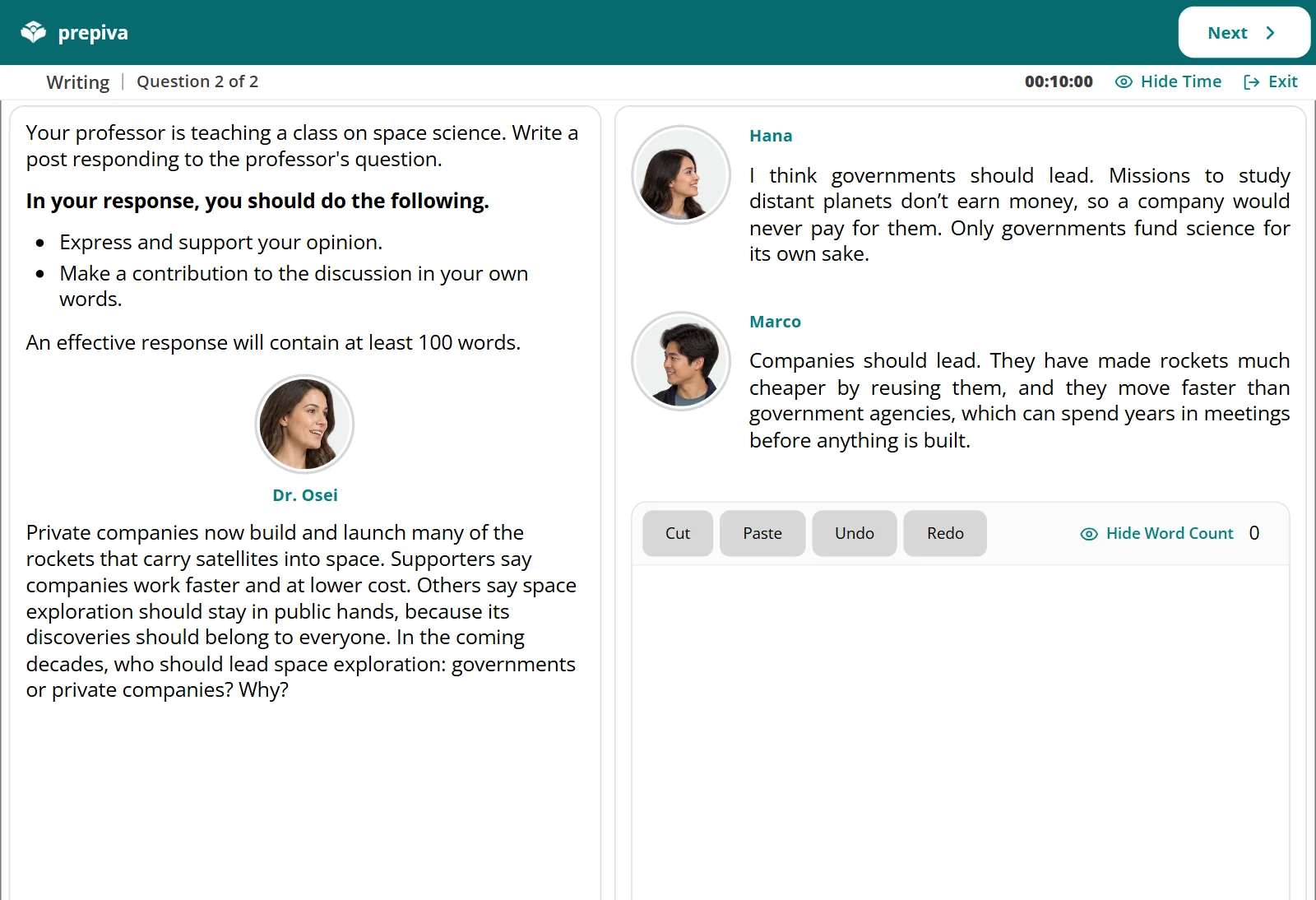
Prepiva practice screen: Writing, Write for an Academic Discussion, with a professor’s question and two student posts
Prepiva practice screen

The prompt (new, written for this page)

Your professor is teaching a class on space science. Write a post that responds to the professor’s question. Give and support your opinion in your own words.

Dr. Osei: Private companies now build and launch many of the rockets that carry satellites into space. Supporters say companies work faster and at lower cost. Others say space exploration should stay in public hands, because its discoveries should belong to everyone. In the coming decades, who should lead space exploration: governments or private companies? Why?

Hana: I think governments should lead. Missions to study distant planets don’t earn money, so a company would never pay for them. Only governments fund science for its own sake.

Marco: Companies should lead. They have made rockets much cheaper by reusing them, and they move faster than government agencies, which can spend years in meetings before anything is built.

Sample post

I agree with Marco that companies can build rockets faster and more cheaply, but I don’t think the choice has to be one or the other. The question neither post mentions is who sets the rules. Thousands of satellites already circle the Earth, and if a company’s old satellite breaks apart, the pieces can damage everyone else’s. Only governments can make rules that every company must follow. In my view, the best model is the one many countries use for airlines: private companies fly the planes, but public agencies decide where they may fly and how safe they must be. Governments could also pay companies to launch science missions like the ones Hana describes. That way, we would get the companies’ speed without losing public control of safety.

What makes it work:

  • The first sentence connects and decides: it credits Marco’s point, then takes a middle position.
  • It adds a new idea: who sets the rules, with the danger of broken satellites, which neither student raised.
  • One familiar example supports it: airlines, where companies operate and public agencies regulate.
  • It answers both classmates: Hana’s concern about science missions gets a solution too.
  • The last sentence sums up the benefit in plain words.

Common mistakes

  • Summarizing the two posts instead of giving your own view.
  • Repeating a classmate’s reason in different words, as in the “before” post.
  • Three vague reasons instead of one developed reason with an example.
  • A long introduction about the topic in general.
  • No time left to check spelling and verb forms.

How to practice

  • Write one 10-minute post a day on a topic from your classes or the news, with a timer.
  • Underline the sentence that adds something new. If you cannot find one, rewrite the post.
  • Count words only after you finish. Prepiva’s guide suggests 120 to 150: enough to develop one idea and still check your work.

Practice on Prepiva

Practice Exam 01, Prepiva’s free full practice test, ends its Writing section with an academic discussion task, and its score report includes a Writing rating after a free sign-up. Prepiva Pro adds Writing practice sets with AI evaluation, for $19.99 a month or $39.99 for 3 months. Next, learn the other Writing tasks: Build a Sentence and Write an Email, or take the full practice test.

FAQ

How many words should my post have?

ETS’s directions say that an effective response contains at least 100 words. Prepiva’s guide suggests 120 to 150, enough to develop one idea and still check your work.

How long do I have?

10 minutes.

Do I have to agree with one of the students?

No. You can agree with one, take a middle position or give a different view, as long as you support it.

Should I mention the other students?

It helps. ETS’s own high-level sample starts by responding to a classmate’s point, then gives its own reasons.

How is the post scored?

From 0 to 5, with ETS’s scoring guide. The Writing section result is a band from 1 to 6, in half steps.