Skip to content

TOEFL iBT® Build a Sentence: how it works, with examples

Build a Sentence opens the Writing section: ten short exchanges in which you put word groups in order to make a correct reply. Each item takes seconds once you see the pattern behind it, and the same patterns come back again and again. This guide gives you a five-step method and eight worked items, one for each pattern, with the extra word group explained. For sample answers to all three Writing tasks, see the Writing sample answers page.

By the Prepiva team · Last reviewed · How we make and review our content

On this page

What Build a Sentence is

  • What you see: a short exchange between two people. The first line is complete. The reply has blanks, and the word groups that fill them are shown in the wrong order. Some words of the reply may already be in place, as in ETS’s own sample.
  • What you do: move the word groups into the blanks to make a complete, grammatical sentence or question that is a natural reply.
  • Extra groups: some items include one group you do not need.
  • How many: ten items, at the start of the Writing section.
  • Time: about 6 minutes for all ten. ETS gives about 23 minutes for the Writing section, and the email and the discussion take 17 of them.
  • Scoring: each item is right or wrong, worth one point.
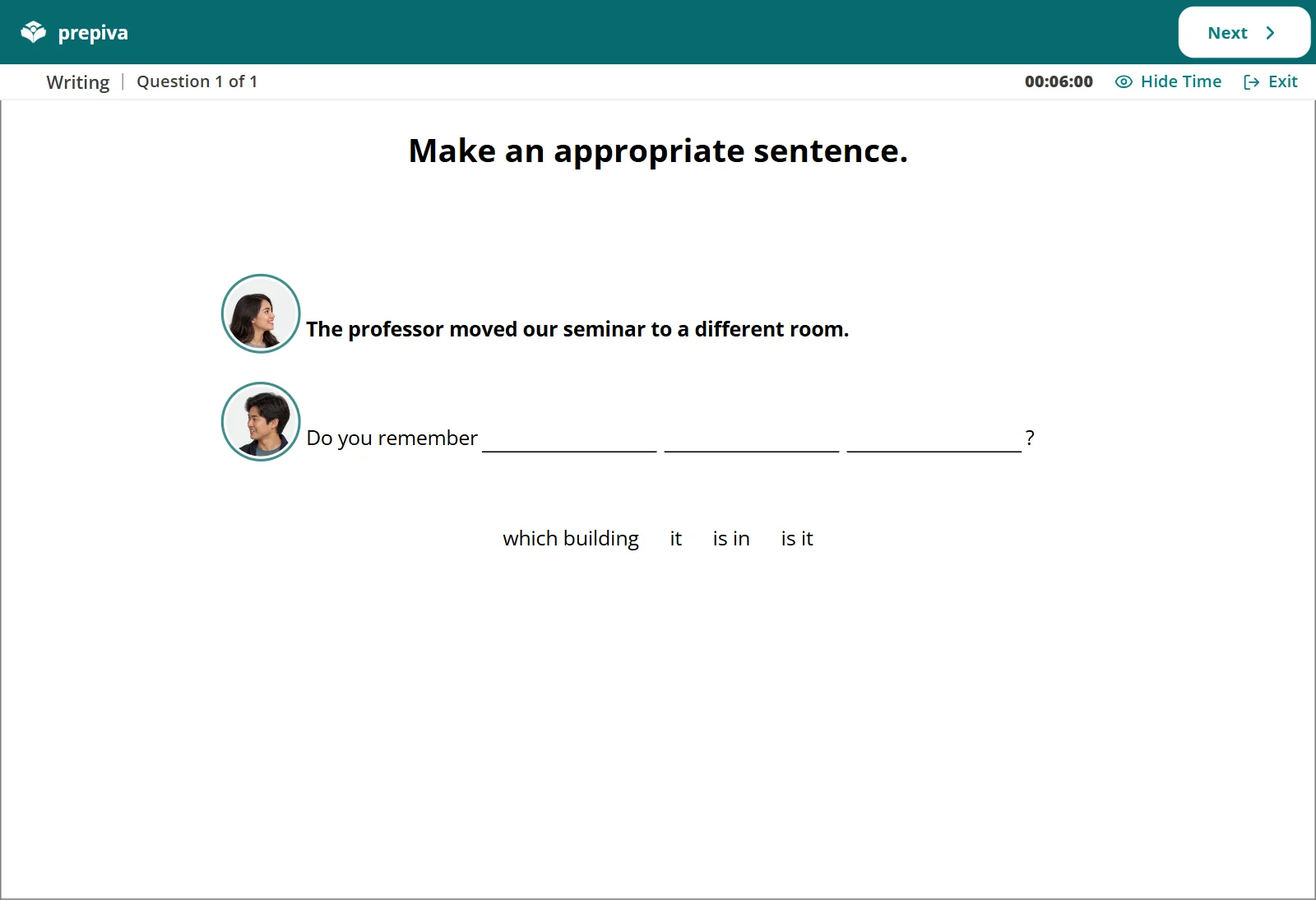
Prepiva practice screen: Writing, Build a Sentence, with word groups to place in a reply
Prepiva practice screen

A five-step method

  1. Read the first line. It tells you what the reply must do: answer a question, react to news or give a reason.
  2. Check the end punctuation. A question mark means question order; a period means statement order.
  3. Find the subject and the verb. Build the core of the sentence first.
  4. Add the rest in the usual order: the object, then the place, then the time.
  5. Check the leftover group. If one group is left, make sure it is the wrong form, then read your sentence once more.

Eight patterns, eight worked items

Each item below is new. The blanks stand for the word groups; the words before and after them are already in place.

1. A statement with a place and a time

Classmate: Where did you leave the lab report?

You: I (3 blanks) .

Word groups:

  • on the professor’s desk
  • before class
  • left it
  • leaving
Show the answer

Answer: I left it on the professor’s desk before class. The verb comes right after the subject, then where, then when. “leaving” is the extra group: it cannot be the main verb without a helper such as “was”.

Not needed: “leaving”

2. A direct question

Friend: I spent the whole weekend at the city’s science festival.

You: Which (4 blanks) ?

Word groups:

  • did you
  • enjoy
  • the most
  • event
  • you did
Show the answer

Answer: Which event did you enjoy the most? The question mark calls for question order: the question word and its noun (“Which event”), then “did”, the subject and the base verb. “you did” is statement order, so it is the extra group.

Not needed: “you did”

3. A question inside a sentence

Classmate: The professor moved our seminar to a different room.

You: Do you remember (3 blanks) ?

Word groups:

  • which building
  • it
  • is in
  • is it
Show the answer

Answer: Do you remember which building it is in? The question inside the sentence uses statement order: “it is in”, not “is it in”. The question mark belongs to “Do you remember…?”, so “is it” is the extra group.

Not needed: “is it”

4. A “who” clause that describes a person

Roommate: Whose camera is that?

You: It belongs to (4 blanks) .

Word groups:

  • a classmate
  • who
  • takes photos
  • for the university website
  • which
Show the answer

Answer: It belongs to a classmate who takes photos for the university website. “who” describes a person and comes right after the noun it describes. “which” is for things, so it is the extra group.

Not needed: “which”

5. The passive

Classmate: Have the exam results come out yet?

You: They (4 blanks) .

Word groups:

  • will be
  • posted
  • online
  • on Friday
  • posting
Show the answer

Answer: They will be posted online on Friday. The results do not post anything; someone posts them, so the sentence needs the passive, “will be posted”. The place comes before the time.

Not needed: “posting”

6. A negative with “still”

Friend: Did you send your application?

You: Not yet. I (3 blanks) .

Word groups:

  • still
  • haven’t written
  • the cover letter
  • didn’t write
Show the answer

Answer: Not yet. I still haven’t written the cover letter. “Not yet” and “still” point to the present perfect: it has not happened up to now. “still” goes before a negative helper verb.

Not needed: “didn’t write”

7. A comparison

Classmate: Why do you always study at the science library?

You: It’s (4 blanks) .

Word groups:

  • much quieter
  • than
  • the one
  • in the student center
  • more
Show the answer

Answer: It’s much quieter than the one in the student center. “quieter” is already a comparison, so “more” is the extra group. “than” introduces what you compare it with.

Not needed: “more”

8. A verb followed by “-ing”

Teammate: What time should we get to Saturday’s game?

You: The coach (4 blanks) .

Word groups:

  • suggested
  • meeting
  • at the field
  • an hour early
  • to meet
Show the answer

Answer: The coach suggested meeting at the field an hour early. “suggest” is followed by an “-ing” form, so “to meet” is the extra group. Learn verbs with the pattern that follows them: “suggest doing”, “decide to do”, “remind someone to do”.

Not needed: “to meet”

How extra groups are built

The extra group is rarely random. It is usually the right word in the wrong form:

  • A different tense or agreement: “didn’t write” next to “haven’t written”, “was” next to “were”.
  • Statement order in a question, or question order in a statement: “you did”, “is it”.
  • A word the sentence already has: “more” next to “quieter”.
  • The wrong word for the noun: “which” for a person.

If two groups look almost the same, the difference between them is the question.

A time plan for ten items

About 6 minutes for ten items gives you about 30 seconds each. Start with the subject and the verb; most items fall into place after that. If an item takes much longer, make your best choice and move on: an empty item earns nothing.

Common traps

  • A time phrase inside the verb: “I have this week been…” instead of “I have been… this week”.
  • No “do”, “does” or “did” in a question: “Where you went?” instead of “Where did you go?”
  • Question order inside an embedded question: “Do you know where is it?”
  • A description far from its noun: keep “who…” and place phrases next to the word they describe.

How to practice

  • Rebuild sentences from your reading: copy a sentence, cut it into four or five groups, mix them and put them back.
  • Say the pattern aloud: “question word, helper, subject, verb”.
  • Time yourself: ten items in 6 minutes, then check every wrong one against the patterns above.

Practice on Prepiva

Practice Exam 01, Prepiva’s free full practice test, starts its Writing section with ten Build a Sentence items, and its score report includes a Writing rating after a free sign-up. Prepiva Pro adds Writing practice sets with more items and AI evaluation of your emails and discussion posts. Next, learn the other two Writing tasks: Write an Email and Write for an Academic Discussion, or take the full practice test.

FAQ

How many Build a Sentence items are there?

Ten, at the start of the Writing section.

How much time do I have?

About 6 minutes for all ten. The Writing section takes about 23 minutes, and the email and the discussion take 17 of them.

Is there partial credit?

No. Each item is right or wrong, worth one point.

Do I have to use every word group?

No. Some items include one group you do not need.

Are some words already in place?

Often, yes. The first or last words of the reply may be given, as in ETS’s own sample.