
TOEFL iBT® Read an Academic Passage: how it works, with an example
Read an Academic Passage is the Reading task closest to what you will read at university: a short text on a subject such as history, science or economics, followed by questions. In 2026 the passages became much shorter than before. This guide explains the task as it is now, the five question types and how to answer each, and works through one new passage question by question. For the whole section, see the Reading practice page.
By the Prepiva team · Last reviewed · How we make and review our content
On this page
What Read an Academic Passage is
- The text: a passage of about 200 words, in two or three paragraphs, with a title. Topics come from areas such as history, art and music, business and economics, life science, physical science and social science. You do not need background knowledge.
- The questions: about five, each with four options.
- Time: the task runs on the Reading section clock. Aim for about 6 to 7 minutes per passage.
- Scoring: one point for each correct answer.
- What you see: the passage stays on the screen while each question appears beside it.
What changed from the old Reading passages
Before January 21, 2026, the Reading section had two passages of about 700 words each, with ten questions for each passage. The 2026 passages are about 200 words with about five questions, and they share the section with two other tasks, Complete the Words and Read in Daily Life. The Reading section now adapts to your level in two stages. If your study materials describe long passages, they describe the earlier test. See the 2026 test format.
The five question types and how to answer each
- Main idea: “What is the passage mainly about?” The right answer fits the whole passage. Reject options that describe only one paragraph or claim more than the passage does.
- Detail: “According to the passage, …” Find the sentence that answers the question and match its meaning, not its words.
- Vocabulary in context: “The word X is closest in meaning to …” Replace the word with each option and reread the sentence. The right choice keeps the meaning, not just the grammar.
- Inference: “What can be inferred about …?” Choose the statement that the passage makes very likely, not one that only sounds reasonable.
- Why the author mentions something: “Why does the author mention X?” Ask which point X supports. The answer is usually in the sentence before or after it.
Worked passage
Read the passage, answer the five questions, then check the explanations.
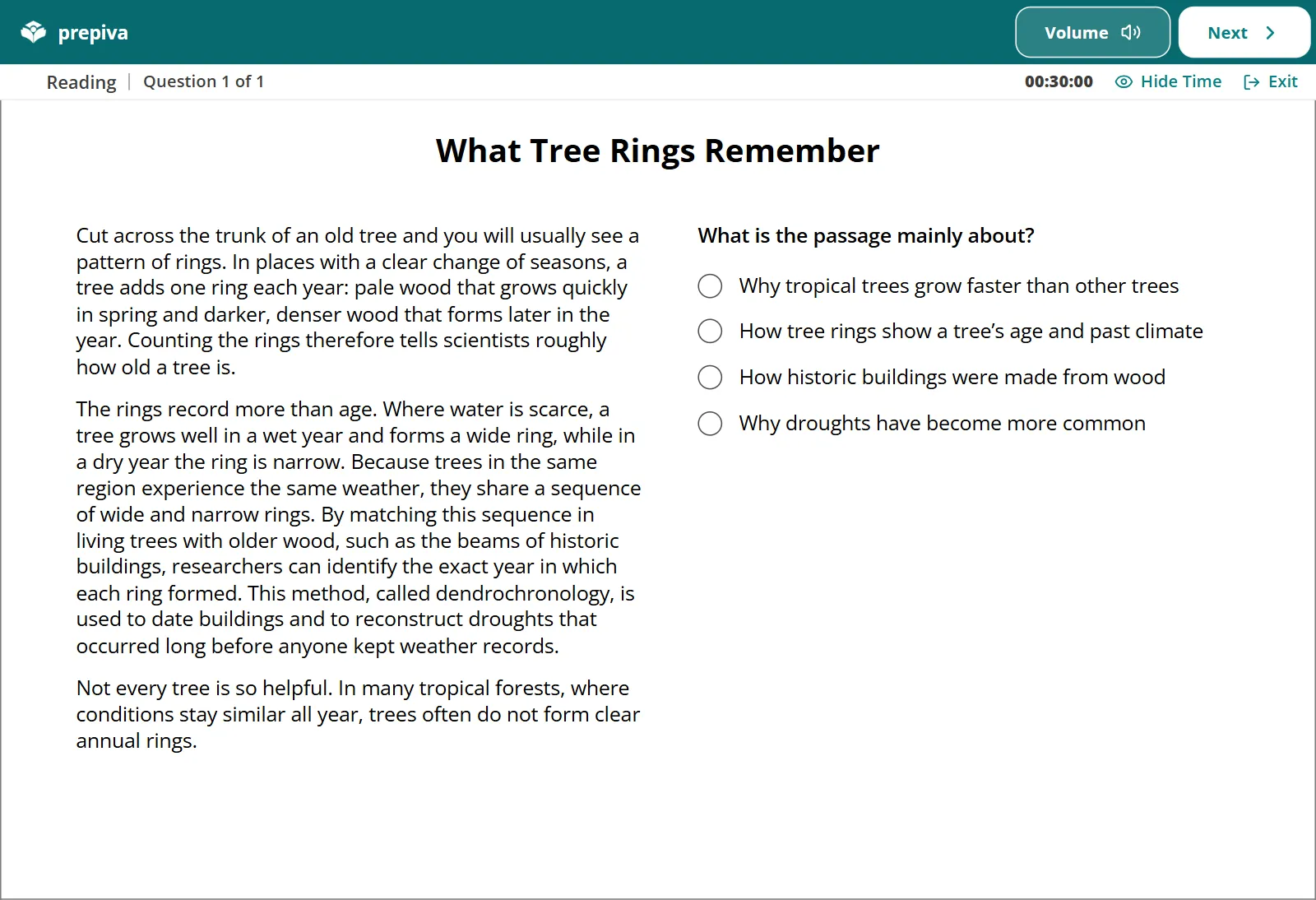
What Tree Rings Remember
Cut across the trunk of an old tree and you will usually see a pattern of rings. In places with a clear change of seasons, a tree adds one ring each year: pale wood that grows quickly in spring and darker, denser wood that forms later in the year. Counting the rings therefore tells scientists roughly how old a tree is.
The rings record more than age. Where water is scarce, a tree grows well in a wet year and forms a wide ring, while in a dry year the ring is narrow. Because trees in the same region experience the same weather, they share a sequence of wide and narrow rings. By matching this sequence in living trees with older wood, such as the beams of historic buildings, researchers can identify the exact year in which each ring formed. This method, called dendrochronology, is used to date buildings and to reconstruct droughts that occurred long before anyone kept weather records.
Not every tree is so helpful. In many tropical forests, where conditions stay similar all year, trees often do not form clear annual rings.
Question 1 (main idea). What is the passage mainly about?
- A.Why tropical trees grow faster than other trees
- B.How tree rings show a tree’s age and past climate
- C.How historic buildings were made from wood
- D.Why droughts have become more common
Show the answer
Answer: B. All three paragraphs are about what rings reveal and where they work. C is the strongest wrong option: the beams are one example in paragraph 2, not the topic of the passage.
Question 2 (detail). According to the passage, why do trees in the same region share a sequence of rings?
- A.They are usually the same age.
- B.They experience the same weather.
- C.They were cut down in the same year.
- D.They grow in the same kind of soil.
Show the answer
Answer: B. “Because trees in the same region experience the same weather, they share a sequence…” A sounds reasonable, but the passage never says it.
Question 3 (vocabulary). The word “reconstruct” in the passage is closest in meaning to
- A.predict
- B.prevent
- C.piece together
- D.measure
Show the answer
Answer: C. Researchers use the rings to build a picture of droughts that happened long ago. D is the strongest wrong option: it sounds scientific, but you cannot measure a drought that ended centuries ago; you can only rebuild a picture of it.
Question 4 (inference). What can be inferred about wood from many tropical forests?
- A.It is too hard to cut.
- B.It may be difficult to date by its rings.
- C.It is never used in buildings.
- D.It grows only in wet years.
Show the answer
Answer: B. If trees “do not form clear annual rings”, counting or matching them is difficult. D copies “wet year” from paragraph 2 but says something the passage does not support.
Question 5 (why the author mentions). Why does the author mention the beams of historic buildings?
- A.To show that old buildings are often damaged by drought
- B.To give an example of older wood that can be dated by matching ring patterns
- C.To explain why scientists cut down old trees
- D.To compare modern and historic building methods
Show the answer
Answer: B. The beams appear as “older wood, such as the beams of historic buildings”, an example inside the explanation of the matching method. A mixes two words from the passage, “buildings” and “droughts”, into a claim it never makes.
How to read a passage in 6 to 7 minutes
- Skim first (about one minute). Read the title and the first sentence of each paragraph. Here, they tell you the line of the passage: rings show age, rings record more than age, not every tree helps.
- Answer in order. For each question, go back to the passage and find the exact sentence before you choose.
- Use the type of question. Main idea questions need the whole passage; detail and vocabulary questions need one sentence; “why mention” questions need the sentences around the example.
- Do not reread everything. The passage stays on the screen, so you only need to know where things are.
Common traps
- “Always” and “never” in an option when the passage hedges with “usually”, “often” or “may”. Paragraph 3 says tropical trees “often” do not form clear rings, not “never”.
- True facts that the passage never states. Choose what the passage supports, not what you know from elsewhere.
- A main idea that fits one paragraph only. Check your choice against every paragraph.
Practice on Prepiva
Prepiva’s three Reading practice sets include academic passages with their own questions. They are free with a Prepiva account, and after each set you can review your answers. Then take the full practice test to get a band for all four sections, or learn the other Reading tasks: Complete the Words and Read in Daily Life.
FAQ
How long is the passage?
About 200 words, in two or three paragraphs, with a title.
How many questions follow a passage?
About five, each with four options.
How much time should I spend on one passage?
About 6 to 7 minutes, including a quick skim before you answer.
Is it like the old TOEFL Reading passages?
No. Before January 21, 2026, the passages were about 700 words long with ten questions each. The 2026 passages are about 200 words with about five questions.
Which question types appear?
Main idea, detail, vocabulary in context, inference, and why the author mentions something.