
TOEFL iBT® Complete the Words: how it works, with examples
Complete the Words is one of the three tasks in the Reading section of the 2026 TOEFL iBT test, and the one most test takers have never seen before. This guide explains how it works, gives you a three-check method for any gap, and walks through two new paragraphs gap by gap. For the whole section, see the Reading practice page.
By the Prepiva team · Last reviewed · How we make and review our content
On this page
What Complete the Words is
- The text: an academic paragraph of about 70 to 100 words.
- The gaps: the first sentence is complete. After that, the second half of every second word is missing, ten words in all. You type the missing letters.
- What it measures: your vocabulary and your ability to use grammar and context to rebuild a text.
- How much it counts: in ETS’s 2026 blueprint, 30 of the 50 Reading items are Complete the Words items, more than either of the other two Reading tasks.
- Time: the task runs on the Reading section clock. Aim for about 2 to 3 minutes per paragraph.
- Scoring: each missing word is one item, worth one point. On Prepiva, a word counts only if every letter is correct.
What you see
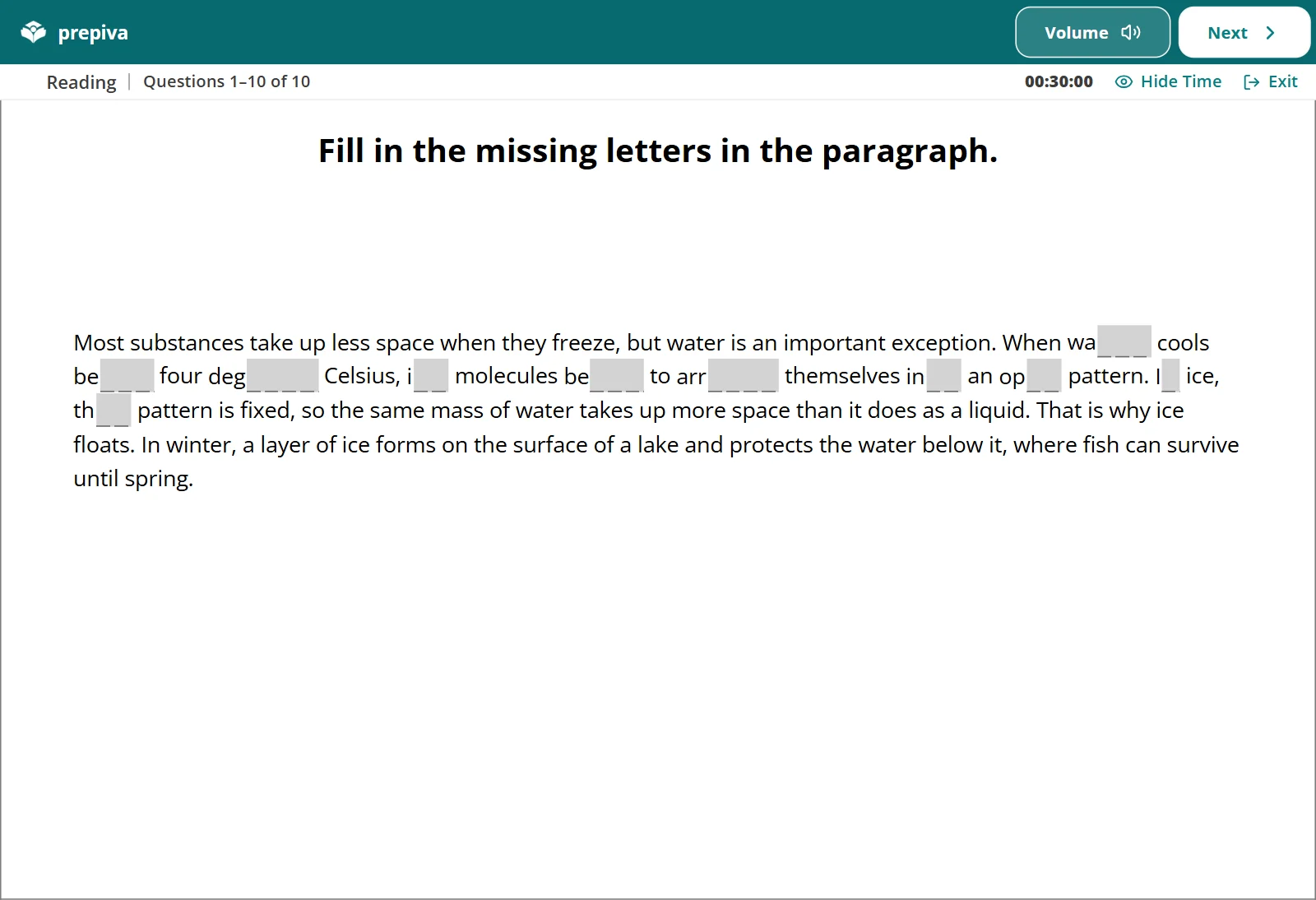
Each missing letter appears as a blank, so you can see exactly how many letters each word needs. In ETS’s sample, a word like “might” appears as “mi” followed by three blanks.
On Prepiva’s practice screen, each box stands for one letter, the cursor moves to the next word when you finish one, and you can select a word to change it or use Back to return to it later in the same Reading module.
Solve any gap in three checks
1. Meaning: what is the paragraph about? Read the whole paragraph before you type. The complete first sentence gives you the topic, and the sentence after a gap often confirms the word.
2. Form: what does the sentence need here? Ask whether the gap is a noun, a verb, an adjective or a small function word, and which form it takes: past or present, singular or plural, an -ing form after “by” or “while”.
3. Length: how many letters are missing? The visible half and the number of blanks usually leave only one word. “rec” with three blanks is “record”, not “recorded”.
Then check the spelling. One wrong letter makes the whole word wrong, and short words such as “the”, “of” and “from” are quick points if you do not rush them.
Worked example 1
Read the paragraph and fill the ten gaps. Each blank stands for one letter.
Most substances take up less space when they freeze, but water is an important exception. When wa (3 missing letters) cools be (3 missing letters) four deg (4 missing letters) Celsius, i (2 missing letters) molecules be (3 missing letters) to arr (4 missing letters) themselves in (2 missing letters) an op (2 missing letters) pattern. I (1 missing letter) ice, th (2 missing letters) pattern is fixed, so the same mass of water takes up more space than it does as a liquid. That is why ice floats. In winter, a layer of ice forms on the surface of a lake and protects the water below it, where fish can survive until spring.
Show the answers
Answers and how the three checks decide them:
- water (wa + 3): the topic from the first sentence; a noun subject before “cools”.
- below (be + 3): a preposition before a number of degrees; “be” plus three letters with this meaning leaves “below”.
- degrees (deg + 4): plural after “four”.
- its (i + 2): a possessive before “molecules”, referring back to water.
- begin (be + 3): a verb before “to arrange”. Note that 2 and 5 start the same way; grammar tells them apart.
- arrange (arr + 4): a verb after “to”, with “themselves” as its object.
- into (in + 2): “arrange themselves into” a pattern. “in” alone would need no blanks.
- open (op + 2): an adjective before “pattern”; the next sentences explain that the pattern takes up more space.
- In (I + 1): a preposition at the start of the sentence: “In ice, …”.
- this (th + 2): “this pattern” points back to the open pattern just described.
Worked example 2
This paragraph is harder. Try it first, then check the answers.
Honeybees that discover a rich source of nectar can share its location with the rest of the colony. Returning fora (4 missing letters) communicate thr (4 missing letters) a beha (4 missing letters) called t (2 missing letters) waggle da (3 missing letters). During ea (2 missing letters) run, t (2 missing letters) dancer mo (3 missing letters) forward wh (3 missing letters) vibrating h (2 missing letters) body, and the angle of that run indicates the direction of the flowers relative to the sun. The duration of the run signals distance: the longer the waggle, the farther the bees must fly. Other workers follow the dancer closely before leaving to search the area.
Show the answers
Answers: 1 foragers, 2 through, 3 behavior, 4 the, 5 dance, 6 each, 7 the, 8 moves, 9 while, 10 her.
The three hardest gaps:
- fora____ → foragers. Meaning: bees that are “returning” with news of food are the ones that collect it. Form: a plural noun, because it is the subject of “communicate”. Length: four letters after “fora” gives “foragers”.
- beha____ → behavior. Meaning: the waggle dance is something bees do. Length decides the spelling: four blanks fit “behavior”. The British spelling “behaviour” would need five.
- wh___ → while. Form: the dancer does two things at once, so the gap joins “moves forward” with “vibrating”. Length: three letters after “wh”. “when” would leave only two blanks, and “which” or “where” do not fit before an -ing verb with this meaning.
Common traps
- The right word in the wrong form: “arrange” where the sentence needs “arranged”, or “degree” after “four”.
- Spending a minute on one hard word while easier gaps wait. Fill the easy words first and come back.
- Ignoring the sentence after the gap. In example 1, “That is why ice floats” confirms that the pattern takes up more space.
- Rushing short function words. “the”, “its” and “in” are quick points, and a typo costs the whole word.
A one-week practice routine
- Days 1 to 5: do one paragraph a day. Before you type, say the three checks aloud for each gap: meaning, form, length.
- Every day: write each word you missed in a short list with its word family, for example “arrange, arranged, arrangement”.
- Day 6: review the list and test yourself on the words, covering the second half of each one.
- Day 7: do a timed Reading set and aim for 2 to 3 minutes per Complete the Words paragraph.
Practice on Prepiva
Prepiva’s three Reading practice sets include Complete the Words paragraphs with their own texts. They are free with a Prepiva account, and after each set you can review your answers. When the task feels familiar, take the full practice test to get a band for all four sections, or learn the next task: Read in Daily Life and Read an Academic Passage.
FAQ
How many words are missing in a Complete the Words paragraph?
Ten. The first sentence is complete, and after that the second half of every second word is missing.
Does spelling count?
Yes. Each missing word is one item, and on Prepiva a word counts only if every letter is correct. Treat spelling as part of the answer.
How long should I spend on one paragraph?
About 2 to 3 minutes. The task runs on the Reading section clock, so a quick, careful first pass matters.
Can I go back and change a word?
On Prepiva’s practice tests, yes, within the same Reading module. On the real test, you cannot go back from the second stage of the Reading section to the first.
Is there partial credit?
No. Each word is right or wrong.