
TOEFL iBT® Read in Daily Life: how it works, with examples
Read in Daily Life is the Reading task built on the short texts you meet every day: notices, emails, schedules, menus and posts. This guide shows the kinds of texts that appear, the four types of questions and how to answer each, and three new texts with every answer explained. For the whole section, see the Reading practice page.
By the Prepiva team · Last reviewed · How we make and review our content
On this page
What Read in Daily Life is
- The texts: short, non-academic texts of about 15 to 150 words, such as a notice, an email or a schedule.
- The questions: two or three multiple-choice questions per text, each with four options. Longer texts get three questions.
- What it measures: whether you can find information quickly, understand the purpose of a text, read informal language and short “note” style, and make simple inferences.
- Time: the task runs on the Reading section clock. Aim for about one minute per question.
- Scoring: one point for each correct answer.
The text stays on the screen while you answer, so you never need to remember it.
The text types and what they ask
| Text type | Typical purpose question |
|---|---|
| Notice, sign or poster | What is being announced, changed or warned about? |
| Email or chain of text messages | What does the writer want the reader to do or know? |
| Schedule or timetable | Which time, day or option fits a person’s situation? |
| Menu, price list, invoice or receipt | What does something cost, or what is included? |
| Social media post or web page | Why did the writer post it, and who is it for? |
| Advertisement or form | What is being offered, and on what conditions? |
Naming the text type first tells you what the purpose question will probably ask.
Four question types and how to answer each
- Purpose: “What is the main purpose of the email?” Name the text type, then ask what the writer wants. The answer covers the whole text, not one detail.
- Detail: “What time does the last ferry leave?” Read the question first, then scan for dates, times, prices, places and conditions such as “only”, “until” or “if”.
- Inference: “What will the reader probably do next?” The answer follows directly from an instruction or a condition in the text.
- NOT or EXCEPT: “Which of the following is NOT true?” Confirm the three options that the text states. The one left over is the answer.
Worked text 1: an email
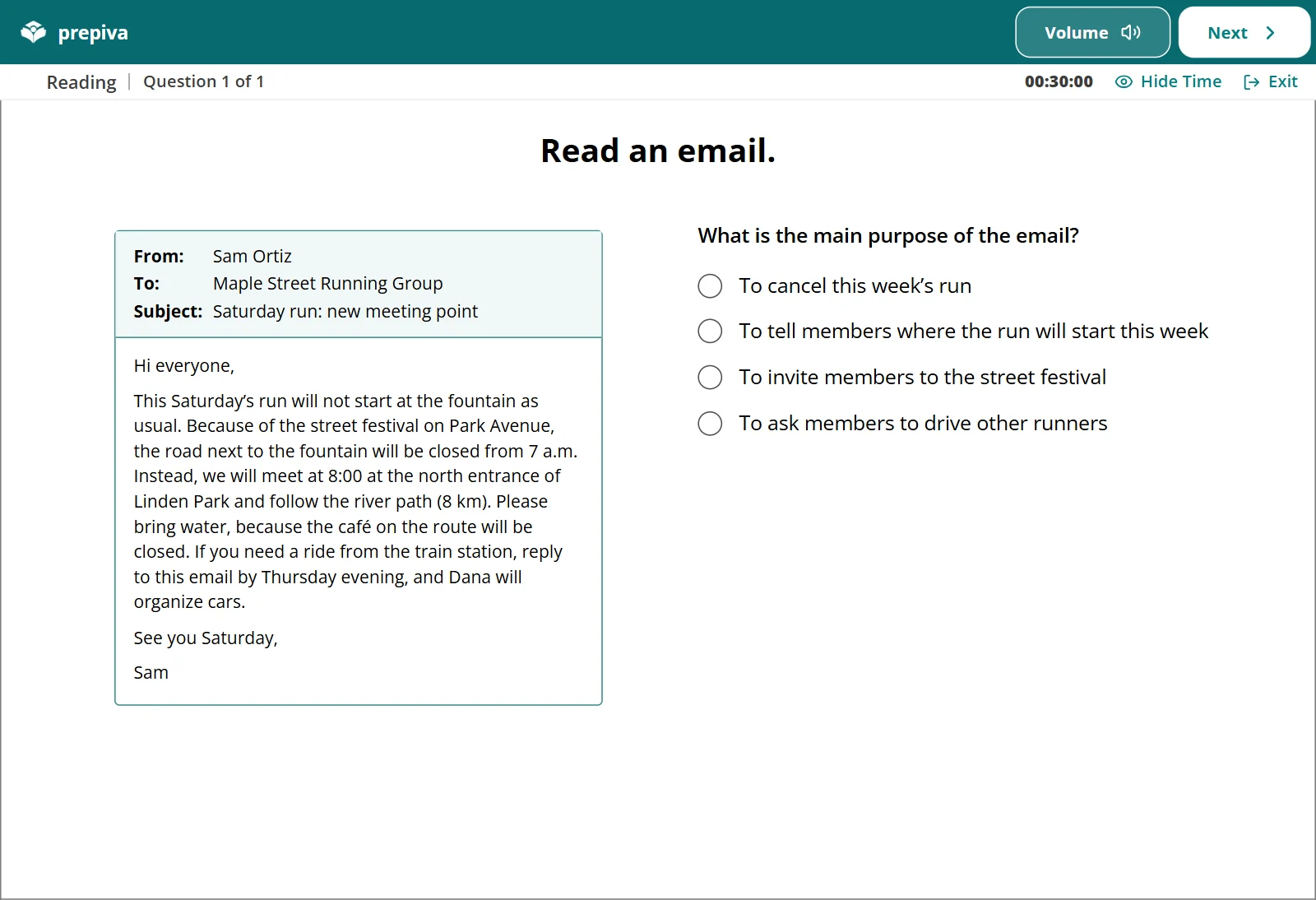
From: Sam Ortiz · To: Maple Street Running Group · Subject: Saturday run: new meeting point
Hi everyone,
This Saturday’s run will not start at the fountain as usual. Because of the street festival on Park Avenue, the road next to the fountain will be closed from 7 a.m. Instead, we will meet at 8:00 at the north entrance of Linden Park and follow the river path (8 km). Please bring water, because the café on the route will be closed. If you need a ride from the train station, reply to this email by Thursday evening, and Dana will organize cars.
See you Saturday,
Sam
Question 1. What is the main purpose of the email?
- A.To cancel this week’s run
- B.To tell members where the run will start this week
- C.To invite members to the street festival
- D.To ask members to drive other runners
Show the answer
Answer: B. The email says the run “will not start at the fountain” and gives the new meeting point. The run is not canceled. The festival is the reason for the change, not an invitation. Dana organizes the cars; members are not asked to drive.
Question 2. What should a member who needs a ride do?
- A.Wait at the fountain at 8:00
- B.Call Dana on Saturday morning
- C.Reply to Sam’s email by Thursday evening
- D.Buy a ticket at the train station
Show the answer
Answer: C. “Reply to this email by Thursday evening”. B is the trap: Dana is in the same sentence, but the email asks readers to reply to Sam, not to call Dana.
Worked text 2: a timetable
Harbor Ferry · Island Route · Departures from City Pier
Monday to Friday: 6:45 · 8:15 · 12:30 · 17:10* · 19:00
Saturday and Sunday: 9:00 · 13:00 · 17:30
* Express sailing: does not stop at Gull Point.
Bicycles: allowed on all sailings except the 8:15.
Tickets: buy at the pier or in the Harbor Ferry app. Cash is not accepted on board.
Question 1. A commuter wants to take her bicycle to the island on a Wednesday morning. Which sailing can she take?
- A.6:45
- B.8:15
- C.9:00
- D.12:30
Show the answer
Answer: A. Wednesday is a weekday, and the 8:15 is the one sailing that does not take bicycles. 9:00 runs only on weekends, and 12:30 is not a morning sailing.
Question 2. Which of the following is NOT true, according to the timetable?
- A.There are three sailings on Sundays.
- B.Passengers can pay for their tickets in cash on board.
- C.The 17:10 sailing does not stop at Gull Point.
- D.Tickets can be bought in an app.
Show the answer
Answer: B. Confirm the other three: Sunday has 9:00, 13:00 and 17:30; the asterisk marks the 17:10 as an express; the app is named under Tickets. B contradicts “Cash is not accepted on board.”
Question 3. A passenger wants to get off at Gull Point after work on a Tuesday. Which sailing should she probably take?
- A.12:30
- B.17:10
- C.17:30
- D.19:00
Show the answer
Answer: D. The 17:10 skips Gull Point, the 17:30 runs only on weekends, and 12:30 is not after work. This is an inference question: the answer combines two lines of the timetable.
Worked text 3: a social media post
Corner Book Box · Elm Street
Thanks to everyone who has used our little book box this year! A few new rules from this week: please take one book and leave one book. We can no longer accept textbooks or magazines, because they fill the shelves too quickly. Children’s books now go on the bottom shelf. We clear out the box every Sunday morning, and anything damaged or wet is recycled.
Question 1. What is the main purpose of the post?
- A.To ask people to donate their textbooks
- B.To explain new rules for using the book box
- C.To announce that the book box will close
- D.To sell children’s books
Show the answer
Answer: B. The post introduces “a few new rules”. A is the opposite of what it says, the box is not closing, and nothing is for sale.
Question 2. What will probably happen to a magazine that someone leaves in the box?
- A.It will be moved to the bottom shelf.
- B.It will be removed during the Sunday clear-out.
- C.It will be given to a school.
- D.It will stay in the box until someone takes it.
Show the answer
Answer: B. Magazines are no longer accepted, and the box is cleared every Sunday morning. A copies words from the post (“bottom shelf”) but that rule is about children’s books. C is never mentioned.
Common traps
- Options that copy words from the text but change who does what or when. In text 1, Dana is mentioned, but the reader replies to Sam.
- Answers that are true in general but not stated in this text. Choose what the text says, not what usually happens.
- Missing a condition. Words such as “only”, “except”, “until” and “if” often decide the answer, as “except the 8:15” does in text 2.
- Answering a purpose question with a detail. The main purpose covers the whole text.
Practice on Prepiva
Prepiva’s three Reading practice sets include Read in Daily Life texts with their own questions. They are free with a Prepiva account, and after each set you can review your answers. Then take the full practice test to get a band for all four sections, or learn the other Reading tasks: Complete the Words and Read an Academic Passage.
FAQ
What kinds of texts are in Read in Daily Life?
Short everyday texts such as notices, signs, emails, text messages, schedules, menus, receipts, forms, advertisements and social media posts.
How many questions does each text have?
Two or three, each with four options. Longer texts get three questions.
How long should I spend per question?
About one minute. The task runs on the Reading section clock.
How do I answer NOT and EXCEPT questions?
Confirm the three options that the text states. The one that is left over is the answer.
Is it scored differently from the other Reading tasks?
No. Each correct answer is worth one point, as in the rest of the Reading section.